



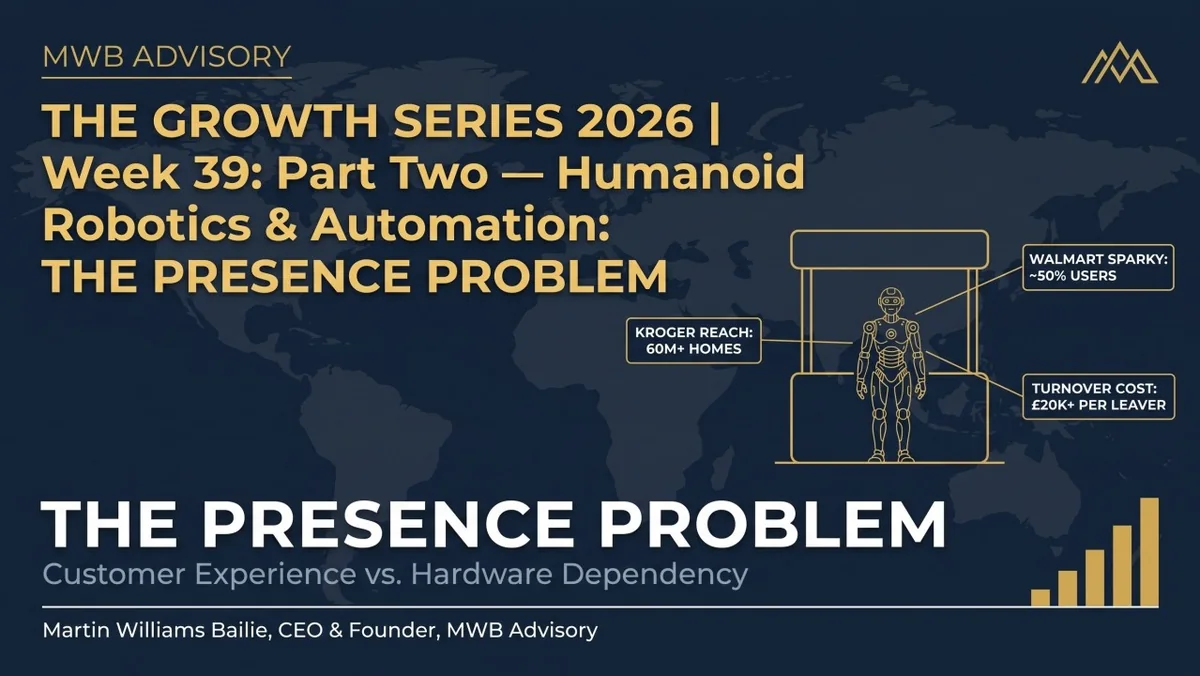
The Growth Series 2026 | Week 39: Part Two — Humanoid Robotics & Automation: The Presence Problem
Martin Bailie CEO & founder MWB advisory Ltd
“Retail spent a decade teaching its systems what customers want. The next decade is about who, or what, those customers actually meet when they need help. “
The Bailie Perspective
Picture a Tuesday evening in a large supermarket. A self-checkout has frozen on an unexpected item in the bagging area. The one colleague covering six tills is dealing with an age check at the other end. The customer, whose loyalty app is full of offers chosen for them by some of the most sophisticated AI in retail, stands alone, waiting for a light to stop flashing.
That moment is the gap I want to write about this week.
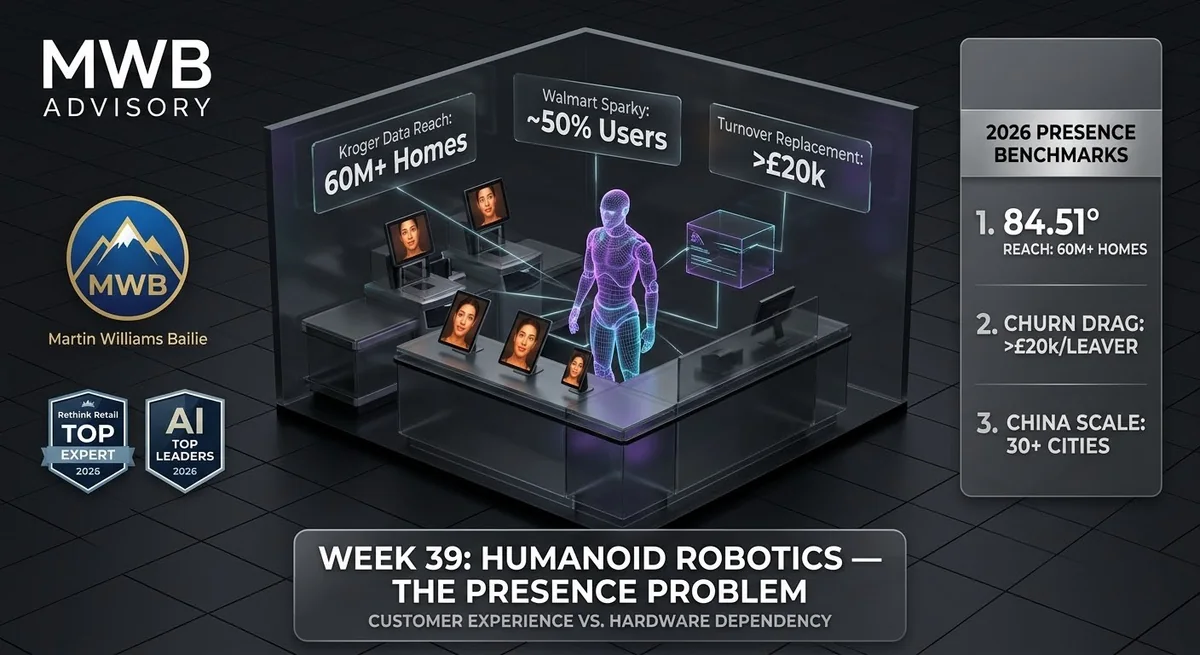
Retail doesn’t have a personalisation problem anymore. It has a presence problem. Tesco has signed a strategic AI partnership with Adobe to personalise Clubcard content and offers, on top of a three-year deal with Mistral AI. Kroger’s 84.51° works from first-party data on more than 60 million US households. About half of Walmart’s app users have already used Sparky, its AI shopping assistant, according to Walmart U.S. CEO David Guggina.
The intelligence is there. It is also invisible. It lives in an app, a chat window, a backend no customer ever meets. Ask a shopper what Tesco’s AI looks like and they can’t tell you, because it doesn’t look like anything. Meanwhile the physical store, where most of the trade still happens, is staffed more thinly every year.
Presence is the missing piece: a consistent, recognisable point of contact that turns all of that intelligence into something a customer or a colleague can actually talk to, at the till, the returns desk, the banking kiosk or the back of house. In Part One I looked at who builds the robots. This week is about who owns that moment.

The Shipyard and the Shop Floor
This week Brittain Ladd published a sharp piece arguing that humanoid robots are the wrong design for shipbuilding. His logic is hard to fault. A ship yard isn’t built for people, welders just endure it. A human-shaped robot inherits every constraint of the human body and adds failure modes of its own. In his words: “Build the robot for the job, not the robot that looks like the person who used to do it.”
I agree with him, and he concedes the point himself: the human-shaped logic works where the world is built for people. I want to take that further, into the store.
A store is the opposite of a ship yard. It is built entirely around people: aisles at human scale, shelves at human height, tills, help points, service desks. More importantly, the hardest work in a store isn’t physical at all. It’s social. Reading a frustrated customer. Handing off to a colleague. Calming a tense moment at the kiosk. Showing a new starter how something is done, for the tenth time, with patience.
That is where the human form earns its place. Not as a cheaper pair of hands, but as a face, a voice and body language people instinctively understand. In the shipyard the humanoid is the wrong robot. On the shop floor, a human presence may be exactly the right interface, even when the machine underneath is a screen on wheels rather than a walking robot.
The Metal and the Mind
For readers in manufacturing and robotics, this is where it gets interesting.
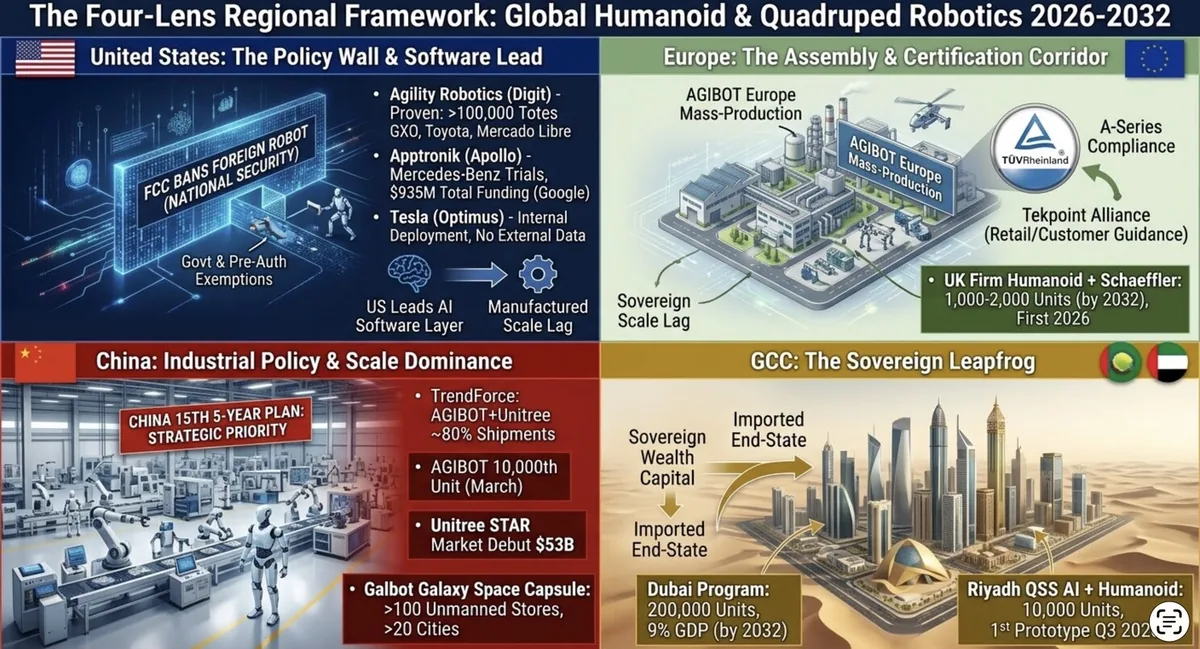
Hardware is scaling fast, and as Part One covered (i will attach part 1 below), much of it is being built in China. Over time that pushes hardware towards a commodity. We have seen this film before. In personal computing, and then in smartphones, the lasting value moved away from the box and towards the layer people actually dealt with: the operating system, the interface, the experience.
Embodied AI looks set to follow the same path. The question for the next decade isn’t only who builds the robot. It’s who owns the layer between the machine and the person in front of it: the behaviour, the expression, the conversation and the trust. That layer is software. It can move across hardware. And it is where a retailer’s brand will actually live.
For manufacturers, that is as much an opportunity as a threat. The robot that wins in a customer-facing environment won’t be the one with the best actuators alone. It will be the one people are comfortable standing next to.
What Presence Does on a Monday Morning
None of this matters if it doesn’t move the P&L. The near-term use cases are less futuristic than the headlines, and that is a good thing:
Colleague Training: High turnover means stores are permanently training. A patient, always-available coach can rehearse a de-escalation, a compliance refresher or a till procedure as many times as a new starter needs. Oxford Economics put the cost of replacing a single retail employee at over £20,000, and every early leaver walks out of the door with that investment.
Customer Service and Banking: A face and a voice placed over the chatbot or knowledge base a retailer already runs, so customers get the same answers, delivered by someone rather than something.
Queues and Peak Trading: Pointing customers to open tills and answering the simple questions before a colleague has to.
Internal Communications: Most large retailers already run a workforce app. A recognisable presence inside it turns a noticeboard into a conversation.
Every one of these runs on hardware stores already have: a screen, a kiosk, a tablet, a phone. The walking robot is not a precondition. That is what makes this a conversation for now, not for 2030.
Who Is Building It
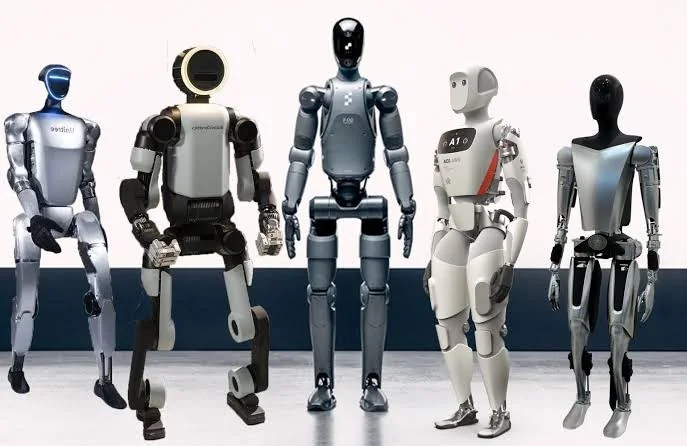
#China is not debating whether presence matters. Galbot says its autonomous, robot-run stores are operating in more than 30 cities. There the robot is the interface, the labour and the brand presence all at once. Whatever the West builds will eventually be judged against that integrated version.
In the West, a different model is emerging: a presence layer that sits on top of whichever hardware a retailer chooses. Thespian Labs is one of the most interesting examples I have come across. Its founding team comes out of MIT, not a robotics factory. CEO Norbert Chang previously led Disney Interactive’s Greater China business and has two founder exits behind him. CTO Dr Çağrı Hakan Zaman holds a PhD from MIT CSAIL. Founding engineer Dr Adam Davis Kraft built LiveLoop, later acquired by Microsoft. Their thesis is simple: the hardware partner provides the metal, Thespian provides the brain, the face, the body and the conversation.
That background in entertainment, design and applied AI shows. Their focus is on how a presence reads a person: expression, gesture, timing, knowing when to step in and when to step back. That is the hard, human part of the problem, and it is where most robotics companies are weakest.
To be precise about where they are: Thespian’s digital human runs today on screens and devices, over systems a business already has. The embodied version, running on partner robot hardware, is in development and has not yet been shown as an integrated retail deployment. That is the honest state of the whole category, not just one company, and it is the right order to build in.
What Has to Be True
Three questions will decide whether presence becomes a category or a curiosity:
1. Does It Last? Presence has to keep earning its place after the first, second and tenth interaction. If it turns out to be a novelty, the thesis weakens. Nobody, me included, has the data yet. The first pilots should be designed to answer exactly this.
2. Does It Redesign the Work? Ladd’s warning applies to retail too. Bolting a new face onto an old process, and swapping a wage for a subscription, won’t change the economics. The value comes from removing steps: the area-manager check that a guided, recorded compliance walk makes unnecessary, the trainer’s hours a coach can carry, the call that never reaches the contact centre.
3. Can It Be Proven? Retail boards should ask the questions Ladd asks of shipyard robots. How often does a human need to step in? How does it recover when it fails? What does a resolved interaction cost? The vendors who publish those numbers first will set the bar for everyone else.
4. Hardware Sourcing Architecture: Whose hardware does the presence promise depend on? A layer that is hardware-agnostic by design is only as resilient as the range of hardware it can actually run on.
Key Performance Indicators & Market Benchmarks
Tesco Personalisation Engine: Strategic AI partnership with Adobe; 3-year deal with Mistral AI | Source: Retail Week / The Grocer / Retail Gazette
Kroger First-Party Data Reach: 84.51° tracking >60 million US households | Source: 84.51° Company Materials
Walmart Sparky Adoption: ~50% of app users engaged with AI shopping assistant | Source: Retail Dive / David Guggina
Frontline Employee Replacement Cost: Over £20,000 per leaver | Source: Oxford Economics (The Cost of Brain Drain) via HRreview
Galbot Autonomous Store Deployments: Active across 30+ cities in China | Source: The Robot Report
Thespian Labs Academic & Industry Pedigree: MIT CSAIL & Design heritage; leadership from Disney Interactive & Microsoft | Source: MIT Professional Education design.mit.edu / Company Materials
Presence Architecture Status: Digital human live on screens/tablets/phones; embodied humanoid robot in development | Source: Operational Audit
The 18-Month Board Take
For Retail Boards:
Named Owners: Chief Customer Officer or Chief Digital Officer, working jointly with the Chief People Officer.
Start with the screen, not the robot: Pilot presence on hardware you already own. Treat any embodied deployment as a separate, later decision.
Pick one moment that matters: A self-checkout intervention, a new starter’s first week, or a peak-trading queue. Measure it before and after.
Ask for proof in writing: What is live, what is next, and what is still roadmap, before any budget is approved.
For Manufacturers and Robotics Leaders:
Design for the shop floor, not the factory: Customer-facing robots will be judged on comfort and trust as much as payload and speed.
Build to host presence: The platforms that make it easy for a presence layer to run on them will be the ones retailers choose.
“The cost of inaction is quiet but real. The retailer who waits will find that a competitor has already decided what its store sounds like, looks like and feels like when a customer needs help, and that customers have got used to it.” — Martin Bailie
Closing Thought:
Part One: the metal is increasingly made in China. Part Two: the presence that will sit on top of it is still being written. The intelligence retail has spent a decade building is finally ready to step forward and meet people. The question for every board is whether it does so in their name.
Sources
Brittain Ladd, “The Wrong Robot for the Job: Humanoids in Shipbuilding,” 30 September 2026.
Tesco and Adobe strategic AI partnership: Retail Week; The Grocer (April 2026).
Tesco and Mistral AI three-year partnership: Retail Gazette (December 2025).
Walmart Sparky usage: Retail Dive, 26 February 2026.
Kroger 84.51° household reach: 84.51° company materials.
Galbot stores: The Robot Report, 23 December 2025.
Retail replacement cost: Oxford Economics, The Cost of Brain Drain (2014), via HRreview.
Thespian Labs team: MIT design.mit.edu; Thespian Labs company materials.