



The Growth Series 2026 | Week 38: Part One of Two — Humanoid Robotics & Automation: The Metal Race
Martin Bailie CEO & founder MWB advisory Ltd
“Cost of inaction: a retailer that commits to a single-hardware roadmap in 2026, ahead of a trade dispute that is nowhere near resolved, is not signing a technology contract. It is underwriting a geopolitical position with a multi-year balance sheet asset. I have never signed off an automation programme without a clear answer to what happens if the primary supplier becomes unavailable inside the asset’s working life. That question just became a live one for humanoid retail hardware.” — Martin Bailie
The Bailie Perspective

Retail leadership has spent two years asking whether AI agents can be trusted with the front door. A more consequential question just arrived on the shop floor itself: who builds the machine standing in it?
“I spent the best part of 2026 inside the room that matters: working directly with global retailers, frontline robotics teams, humanoid manufacturers, and the breakthrough embodied AI start-up built to transform physical retail labour. This two-part series is not desk research—it is the distillation of months spent stress-testing whether the hardware, the unit economics, and the geopolitical supply lines actually survive contact with a real shop floor. If your board is evaluating humanoid automation as a standard tech pilot, this series will challenge how you sequence your capital.” — Martin Bailie

On 29 July 2026, the US Federal Communications Commission banned the import of new foreign-made humanoid robots, citing an unacceptable risk to national security. Beijing called it protectionism. Neither side disputed the number underneath the decision. China’s manufacturers shipped over 80 percent of the roughly 16,000 humanoid robots deployed worldwide in 2025, led by AGIBOT and Unitree Robotics . American rivals Tesla and Figure AI each shipped a few hundred units or fewer.
This is not a story about who has the better research lab. The United States leads on the AI software stack, and no serious analyst disputes that. This is a story about who has the factory, the rare-earth supply chain, and the state backing to turn a demonstration into a fleet. A retailer evaluating a humanoid pilot in 2026 is not choosing a vendor. They are choosing a side in a supply chain that a G7 government has just formally classified as a national security question.
I spent a large part of my career building distribution centres and signing off automation roadmaps, from Lidl’s first automated GB and Irish facilities through to the omnichannel rebuild in India. Every one of those capital decisions was tested the same way: does the business case survive first contact with the supply chain, not the demo on the trade show floor? A humanoid pilot that looks identical to a board in September can carry two entirely different risk profiles by the time it is due for renewal, depending on which government has decided its hardware is a security threat by then. That is not a new problem in retail automation. It is the oldest one, wearing a new face. I have sat in capital committees where the vendor’s roadmap slide was the least reliable page in the deck, and the answer was always the same: sequence the bet so the business case still stands if that page turns out to be wrong.
The scale of the current commercial gap is what makes this urgent rather than theoretical. Morgan Stanley more than tripled its 2026 China shipment forecast over the course of this year, from 14,000 units in January to 50,000 units by June, citing faster-than-expected commercial deployment. Unitree, one half of China’s duopoly, went public on Shanghai’s STAR Market on 19 August 2026 and closed its first day up 487 percent, at a valuation of roughly 53 billion dollars, after shipping just over 5,500 humanoids the year before. There is no equivalent Western proof point. Agility Robotics , the most commercially mature US player, has moved totes at GXO Logistics, Inc. and Amazon warehouses, which is real, but it is a warehouse story, not a shop floor story. Retail has not yet had its own version of this decision. Part One is about the ground that decision will stand on.
The Four-Lens Regional Framework
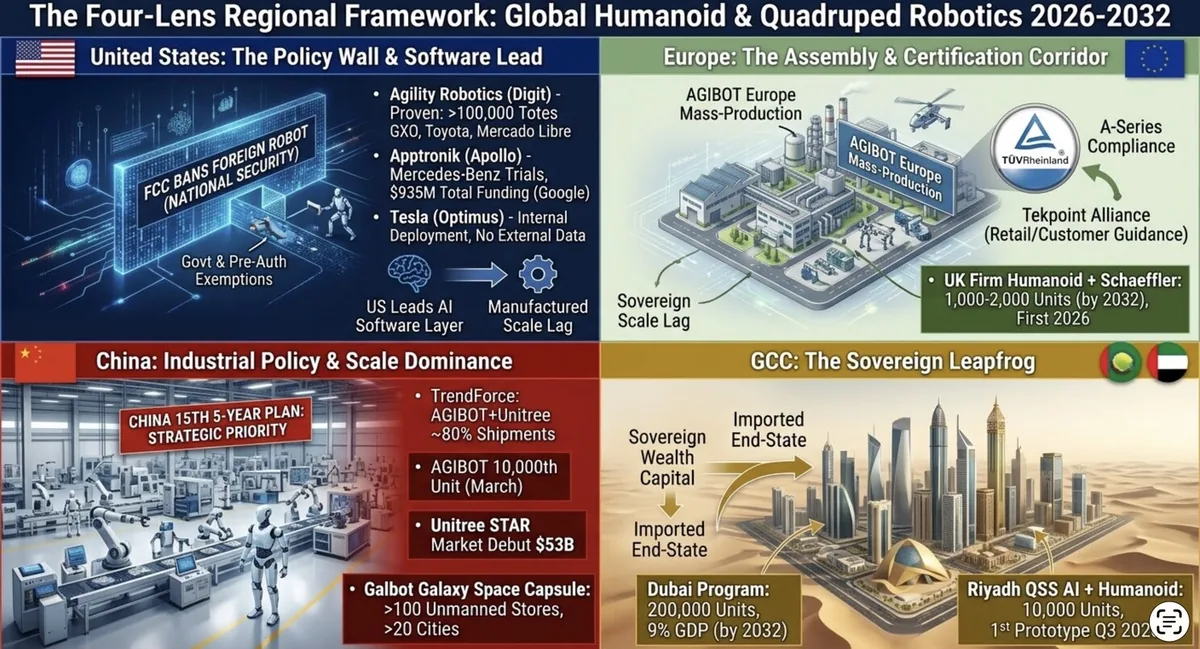
United States (The Policy Wall & Software Lead):
The FCC’s 29th July ban is the defining event of the US lens, restricting new imports of foreign-made humanoid and quadruped robots on national security grounds, with exemptions for government use and previously authorised models.
Commercially, Agility Robotics remains the most proven operator, having moved over 100,000 totes at GXO facilities and added Toyota and Mercado Libre as customers. Apptronik’s Apollo is deployed for testing with Mercedes-Benz, backed by a 520 million dollar Series A that brought its total funding to 935 million dollars, with Google among the strategic investors. Tesla Optimus remains an internal-factory deployment without published production counts or confirmed third-party retail availability. The US leads the AI software layer and lags badly on manufactured scale, and its own government just made that gap a matter of formal policy.
Europe (The Assembly & Certification Corridor):
Europe’s humanoid manufacturing capacity is, for now, largely being built by the country the FCC ban targets. AGIBOT opened the continent’s first humanoid mass-production line in Serbia and, at IFA 2026 in Berlin, secured TÜV Rheinland compliance certification for its A-Series alongside a distribution alliance with Tekpoint aimed squarely at European retail assistance and customer guidance deployments.
Separately, UK-headquartered firm Humanoid signed a partnership with Schaeffler to deploy between 1,000 and 2,000 units across its manufacturing sites by 2032, with initial deployments from December 2026. Europe is choosing which non-domestic supplier to depend on rather than building sovereign hardware scale.
China (Industrial Policy & Scale Dominance):
AGIBOT and Unitree together are projected by TrendForce to capture close to 80 percent of Chinese shipments in 2026, with AGIBOT producing its 10,000th unit by late March. Following Unitree’s $53 billion STAR Market debut, AGIBOT is pursuing a Hong Kong listing targeting 5.1 to 6.4 billion dollars, backed by Tencent, HongShan Capital, LG Electronics, and BYD. On the retail floor, Galbot unmanned Galaxy Space Capsule c-store format has expanded past 100 locations across more than 20 Chinese cities, operating around the clock without staff. Under China’s 15th Five-Year Plan (2026-2030), embodied AI is a designated strategic priority industry alongside quantum computing and 6G.
GCC (The Sovereign Leapfrog):
The Gulf fits the Sovereign Leapfrog Framework precisely: no legacy retail-automation estate to unwind, capital-first sequencing through sovereign wealth, and an imported end-state rather than a domestically developed one. Dubai’s Robotics and Automation Program targets a 9 percent contribution to Dubai’s GDP by 2032 through deployment of 200,000 robotic units. Riyadh-based QSS AI & ROBOTICS partnered with the UK’s Humanoid to deliver up to 10,000 humanoid robots over five years, with a first prototype expected in Q3 2026.
Named Execution Case Studies
Unitree’s STAR Market Debut: The first pure-play humanoid robotics company to receive a public, market-set price, oversubscribed roughly 8,000 times by retail investors and closing its first day up 487 percent at ~$53 billion. Every private humanoid valuation globally—including AGIBOT—is now being measured against this benchmark, whether or not that comparison is fair to a pre-revenue Western competitor.
AGIBOT’s Serbia Plant & Tekpoint Alliance: The more consequential story for European retailers than the IPO headline. A Chinese manufacturer building inside the European regulatory orbit and signing distribution specifically aimed at retail assistance and customer guidance is building the service, parts, and compliance network a retailer requires before committing to a multi-year hardware contract.
Agility Robotics at GXO: The clearest verified Western commercial deployment, surpassing 100,000 tote moves. However, retail leaders using this as evidence that Western humanoid capability is ready for the customer-facing retail floor are reading the case study wrong; it remains a warehouse logistics deployment.
Reality Check: The 2.8x Decoupling Penalty
The FCC ban will not meaningfully slow China’s humanoid development; its domestic market and other export destinations (Europe and the Gulf) are large enough to absorb the loss of US market access. What it will materially slow is American and Western retailers’ route to the cheapest, most field-tested equipment on the market.
McKinsey Operations supply chain analysis confirms that assembling a comparable humanoid robot completely decoupled from Chinese components raises the bill of materials from $46,000 to $131,000—close to three times the cost (a 2.8x premium). This gap exists because China controls approximately 69 percent of global rare-earth mining and 90 percent of permanent magnet processing capacity.
Furthermore, market-size forecasts in this category should not be repeated as settled fact: five named research houses put the 2026 global humanoid market anywhere between $1.4 billion and $10.7 billion—a wider spread than almost any other technology category tracked. Any single number quoted without stating its underlying methodology is marketing, not analysis.

Key Performance Indicators & Market Benchmarks
2025 Global Humanoid Shipments / China Share: ~16,000 units; China share >80% | Source: Industry Disclosures
2026 China Shipment Forecast (Revised): 50,000 units (up from 14,000 in Jan) | Source: Morgan Stanley
2026 US Comparable Production: A few hundred units or fewer (Tesla + Figure AI combined) | Source: Industry Consensus
China Rare-Earth Control: ~69% of global mining; ~90% of permanent magnet processing | Source: Global Supply Chain Data
China-Free Humanoid BOM Cost Premium: ~2.8x cost increase ($46,000 to $131,000 comparable) | Source: McKinsey Supply Chain Analysis
Unitree IPO Valuation (19 Aug Close): ~$53BN on Shanghai STAR Market | Source: Shanghai Stock Exchange
AGIBOT Target Listing Valuation: $5.1BN–$6.4BN Hong Kong target | Source: Pre-IPO Filings
2026 Global Market Size Range: $1.4BN to $10.7BN across five research houses | Source: Aggregated Research Spine
The 18-Month Board Take
Named Owner: Chief Supply Chain Officer (or CTO where no CSCO role exists), applying the Bailie Agility
Framework:
1. Sequencing Not Simultaneity: Do not run a hardware pilot and a customer-experience pilot as a single programme. The FCC ban proves hardware sourcing is now a live geopolitical variable, completely independent of the operational software use case sitting on top of it.
2. A Single P&L Conversation, Not Two: Put the China-dependency cost premium in front of the capital committee inside the same business case as the labor-saving upside, not as a footnote added after the figures the vendor supplied.
3. Proof Before Commitment: Trial the use case on the most field-proven, accessible hardware in your jurisdiction before locking a five-to-seven-year capital asset to a single-region supply chain.
“Cost of inaction: a retailer that commits to a single-hardware roadmap in 2026, ahead of a trade dispute that is nowhere near resolved, is not signing a technology contract. It is underwriting a geopolitical position with a multi-year balance sheet asset. I have never signed off an automation programme without a clear answer to what happens if the primary supplier becomes unavailable inside the asset’s working life. That question just became a live one for humanoid retail hardware.” — Martin Williams Bailie

Coming Next in Part Two:
Week 39: The Presence Problem. Growth Series goes inside Thespian Labs’ bet that owning the hardware race matters far less than owning the conversation happening on top of it, asking whether a Western customer-experience layer built on Chinese hardware is a viable long-term strategy or an unpriced dependency.