


The Growth Series 2026 | Week 36: General Merchandise & Fulfilment – After the Click: General Merchandise in the Age of the Shopping Agent
Martin Bailie CEO & founder MWB advisory Ltd
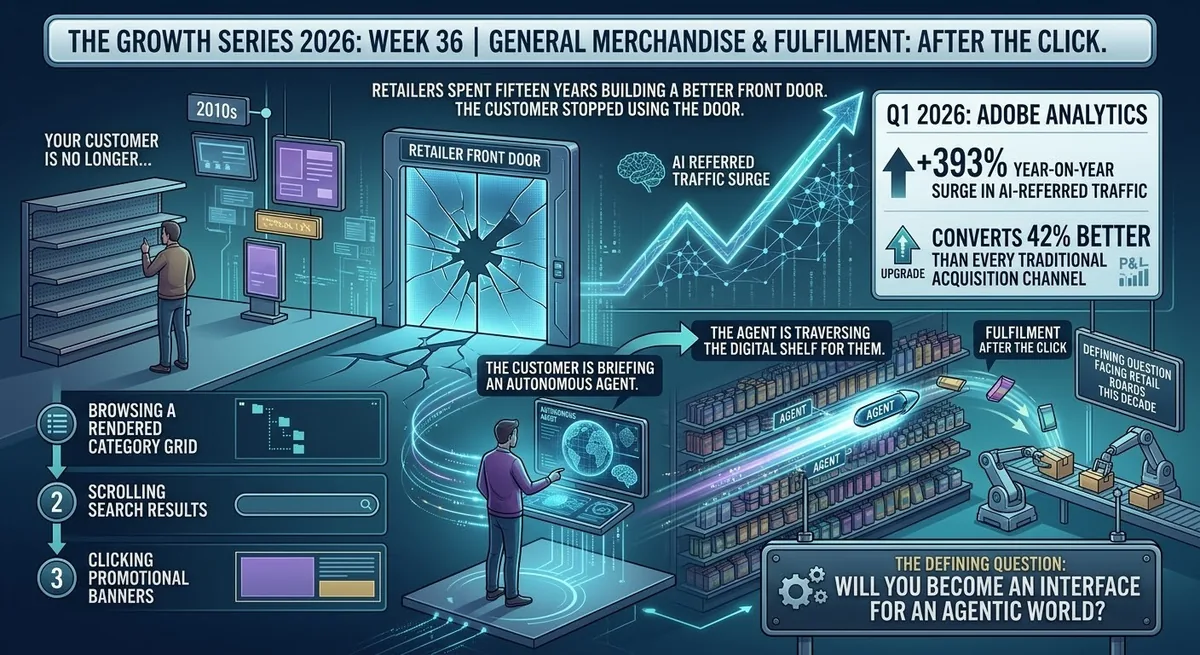
Retailers spent fifteen years perfecting a better digital front door. The customer stopped using the door.
“The question isn’t whether you need an AI strategy. It’s whether you own the interface, or become a shelf in somebody else’s store.” — Martin Bailie
The Bailie Perspective
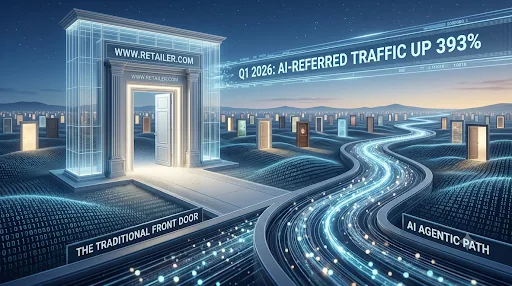
Adobe Analytics measured a 393 percent year-on-year explosion in AI-referred traffic to US retail websites in the first quarter of 2026. Crucially, that traffic converts 42 percent better than legacy digital channels. The shift in consumer behavior is definitive: customers are no longer manually browsing through category pages or relying on keyword search queries. They are delegating intent to autonomous agents that browse, compare, and assemble carts on their behalf.
This is not an abstract technology story. It is an uncompromising test of catalog discipline. An agent cannot recommend or buy what it cannot ingest; it can only transact with an enterprise whose structured attributes, localised inventory visibility, dynamic fulfilment windows, and pricing rules are formatted cleanly for direct machine reading. That is pure store operations and supply-chain precision.
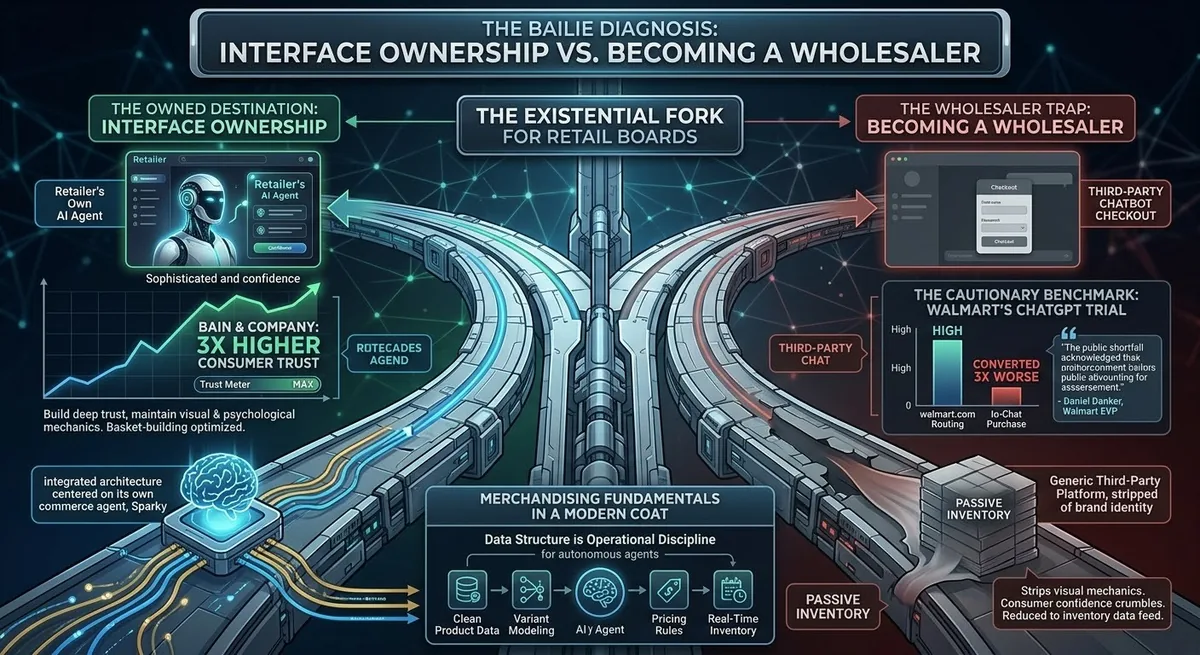
Having run operations across massive physical and omnichannel estates—including as COO of Lidl UK/IE, CEO of Tesco Tata India —I know that when customer acquisition routes change, your back-end systems determine your survival. The market has reached a critical strategic fork: Bain & Company finds shoppers have three times higher trust in a retailer’s own AI agent than an unvetted third-party bot to complete an actual purchase. Either you build and govern an agentic interface your consumer trusts, or you become commoditised inventory sitting on a digital shelf in somebody else’s ecosystem.
The Walmart ChatGPT Case Study
The clearest operational proof point of 2026 comes directly from Bentonville.
Walmart made approximately 200,000 SKUs available for direct purchase inside ChatGPT via Instant Checkout. The result was an immediate operational lesson: purchases completed entirely inside the third-party chat interface converted at one-third the rate of transactions where shoppers clicked through to Walmart’s owned website.
The friction was structural:
⁃ Isolated single-item purchases broke the unified basket experience, disconnecting impulse buys from everyday grocery and general merchandise baskets.
– Third-party chat windows stripped away the trust, visual affirmation, and seamless payment integration consumers expect from an established retail app.
Walmart pivoted in public. Daniel Danker , EVP of product and design, retired the disconnected in-chat flow in favor of embedding Walmart’s own commerce agent, Sparky, to handle authentication, cart synchronisation, and checkout on Walmart’s own rails. If the world’s largest retailer with unmatched scale cannot convert off-site chatbot commerce, mid-market retailers must immediately abandon the fantasy that third-party agent integration is a plug-and-play solution.
The Four-Lens Regional Framework
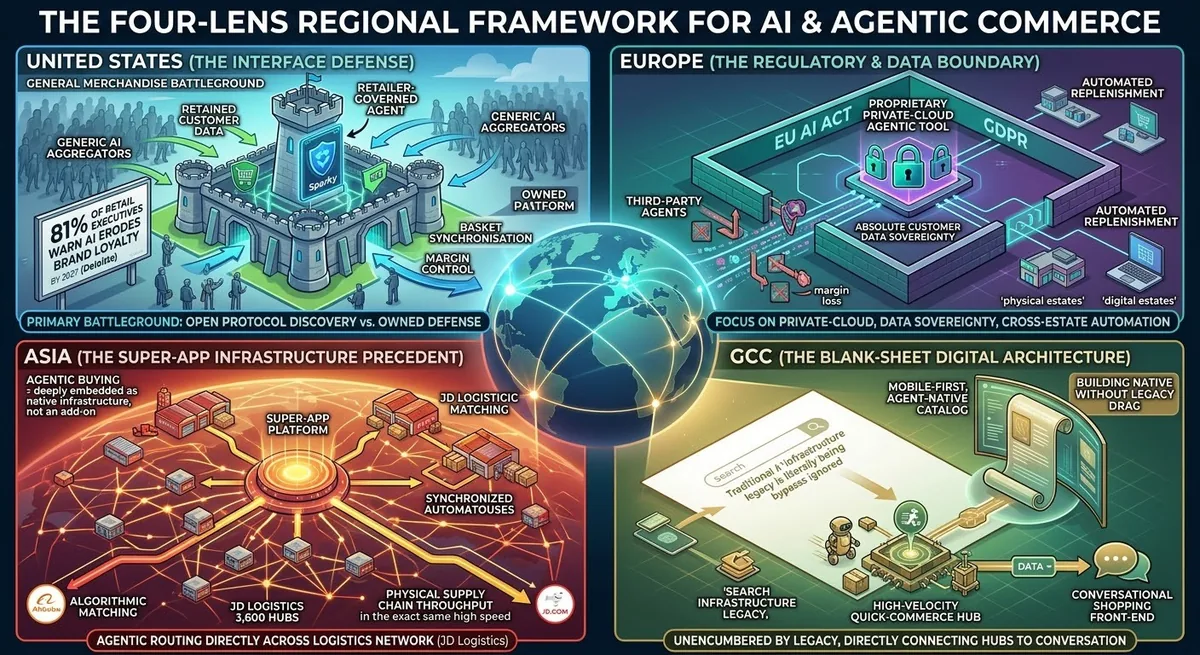
#United States (The Interface Defense): US general merchandise is the primary battleground between open protocol discovery and owned platform defense. With 81% of retail executives warning that AI will erode brand loyalty by 2027 (Deloitte), the race is on to deploy retailer-governed agents (like Walmart’s Sparky) that retain customer data, basket synchronisation, and margin rather than ceding the transaction to generic AI aggregators.
#Europe (The Regulatory & Data Boundary): European operators are approaching agentic commerce under the strictures of the EU AI Act and GDPR. Because third-party agents extract proprietary customer behavior and transactional margin, European retailers are focusing heavily on proprietary, private-cloud agentic tools that maintain absolute customer data sovereignty while automating replenishment across physical and digital estates.
#Asia (The Super-App Infrastructure Precedent): In China and Southeast Asia, agentic buying is not an external add-on—it is native infrastructure. Platforms like Alibaba.com and JD.COM have embedded agentic routing directly across logistics networks (such as JD Logistics’ 3,600 hubs), proving that autonomous shopping works only when physical supply chain throughput moves at the exact same speed as algorithmic matching.
#GCC (The Blank-Sheet Digital Architecture): GCC retailers are bypassing legacy e-commerce search infrastructure entirely. Unencumbered by multi-decade web legacy drag, regional leaders are building mobile-first, agent-native catalogs that connect high-velocity quick-commerce hubs directly to conversational shopping front-ends.
Reality Check: The 81% Loyalty Warning
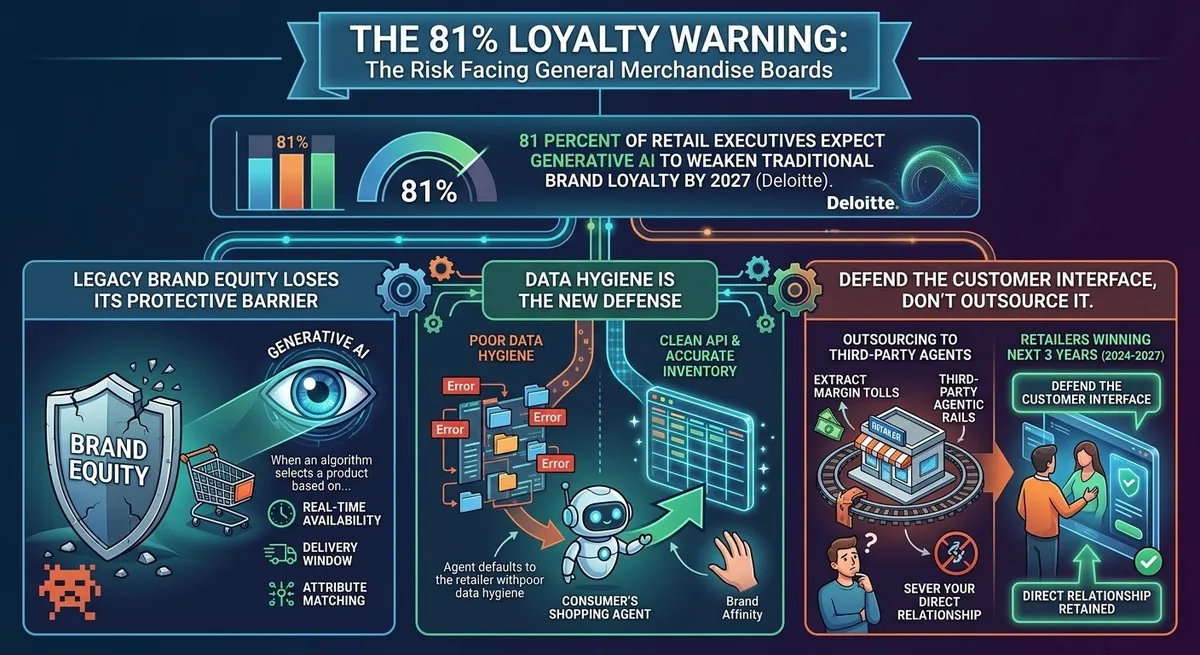
The risk facing general merchandise boards is clear: 81 percent of retail executives now expect generative AI to weaken traditional brand loyalty by 2027 (Deloitte).
When an algorithm selects a product based on real-time availability, delivery window, and attribute matching, legacy brand equity loses its protective barrier. If a consumer’s shopping agent defaults to the retailer with the cleanest API and the most accurate real-time inventory, brand affinity will not save an operator with poor data hygiene.
Furthermore, third-party agentic rails extract margin tolls and sever your direct relationship with the consumer. The retailers winning the next three years will be those that defend the customer interface rather than outsourcing it.
Key Performance Indicators & Market Benchmarks
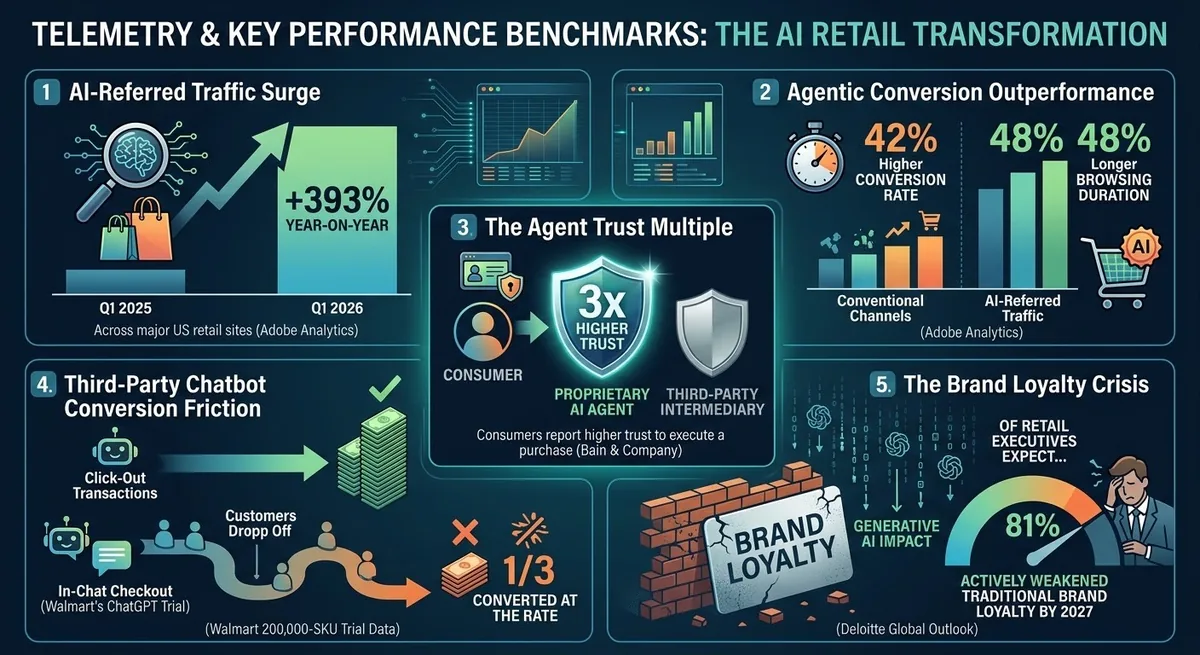
AI-Referred Retail Traffic Growth: +393% YoY in Q1 2026 across major US retail sites | Source: Adobe Analytics
Conversion Rate Advantage: AI-referred traffic converts 42% better than traditional acquisition channels | Source: Adobe Analytics
Engagement Duration: AI-referred shoppers browse 48% longer than traditional site visitors | Source: Adobe Analytics
Proprietary Agent Trust Advantage: 3x higher trust in a retailer’s own AI agent to complete a purchase versus third-party tools | Source: Bain & Company
In-Chat Conversion Gap: Purchases inside third-party chat interfaces converted 3x worse than click-throughs to owned web domains | Source: Walmart Corporate Commentary / Search Engine Land
Executive Brand Loyalty Concern: 81% of retail executives project generative AI will weaken brand loyalty by 2027 | Source: Deloitte Retail Industry Global Outlook
The 18-Month Board Take
0–6 Months (Audit Catalog Machine-Legibility): Structure your entire general merchandise SKU base for direct algorithmic ingestion. Ensure attributes, dimensions, stock levels, and fulfillment parameters are exposed via clean APIs rather than locked in flat HTML pages. (Owner: Chief Commercial Officer & Chief Information Officer)
6–12 Months (Enforce Interface Ownership): Follow Walmart’s strategic pivot: refuse to cede direct cart building, payment, and customer authentication to external chat platforms. Build lightweight, proprietary conversational agents inside your owned digital footprint where conversion rates and basket sizes are protected. (Owner: Chief Digital Officer)
12–18 Months (Align Fulfilment Latency to Agentic Velocity): An agent can complete an order in milliseconds; if your physical distribution network cannot confirm stock availability or fulfill in tight delivery windows, the agent will reroute future orders to a competitor. Tie in-store inventory accuracy directly into your automated fulfillment logic. (Owner: Chief Operating Officer)

The Question for Every Board:
“The question is no longer whether you need an AI strategy. The question is whether you own the interface, or become a shelf in somebody else’s store. “
Week 33–36: The Executive Roadmap
Week 33: Convenience & Emerging Markets – The Unbuilt Advantage.
Week 34: Grocery – The Label Dividend & The Label Equity Audit.
Week 35: Fashion & Apparel – The Undiscoverable Estate & The Discoverability Audit.
Week 36: General Merchandise & Fulfilment – After the Click: The Age of the Shopping Agent.