
The Growth Series 2026 | Week 34: Grocery – The Label Dividend
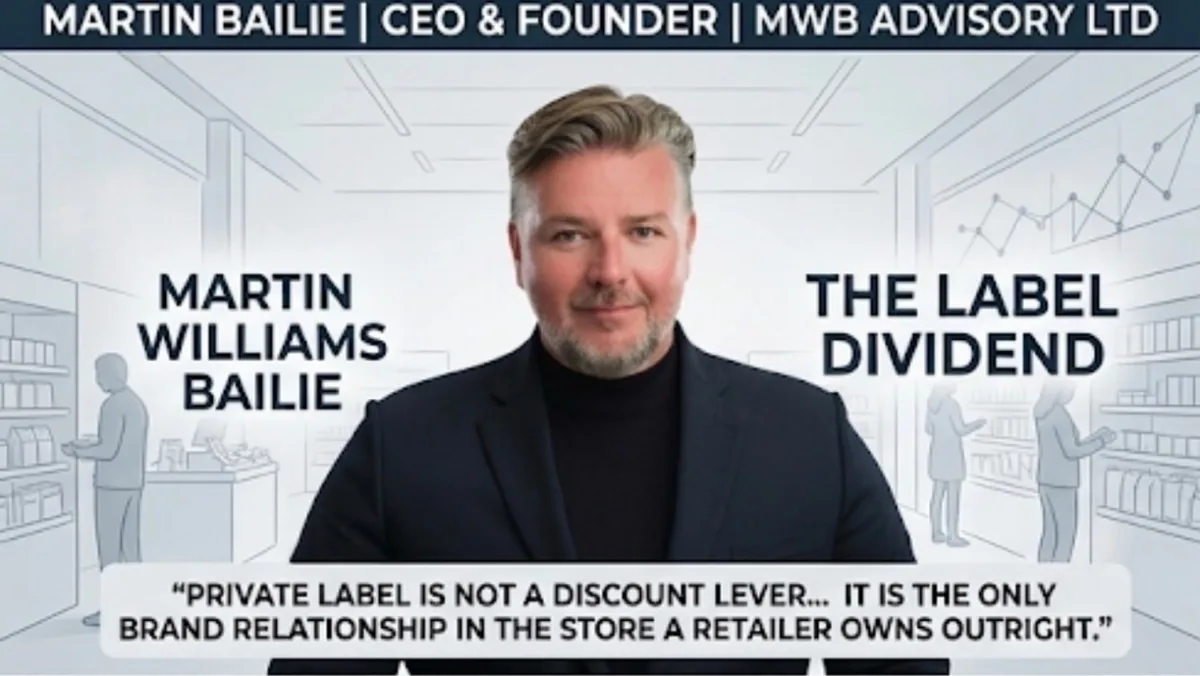
Martin Bailie CEO & founder MWB advisory Ltd
Private label is not a discount lever a retailer pulls when national brands get expensive. It is the only brand relationship in the store a retailer owns outright.” — Martin Bailie , Retail Technology Innovation Hub
Every board I sit in front of still asks private label the same question they asked in 2010: how do we make it cheaper? That was the right question then. It is the wrong one now.
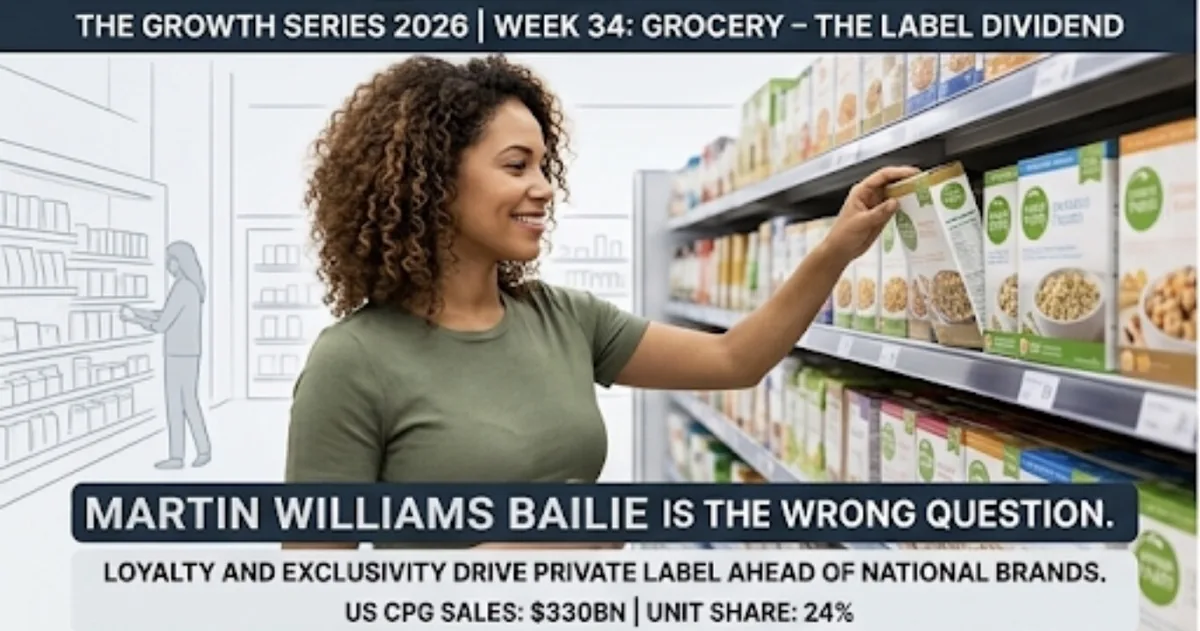
The scale shift is the story. Circana reports US private label CPG sales have reached 330 billion dollars, a 24 percent unit share and a 23 percent dollar share of the total market. Circana’s own chief advisor, Sally Lyons Wyatt , does not credit price for that growth. She points to loyalty and exclusivity as the drivers keeping private label ahead of national brands even as household budgets tighten. That is a different claim than the one most boards are still working from.
Private label is not a discount lever a retailer pulls when national brands get expensive. It is the only brand relationship in the store a retailer owns outright: no wholesale negotiation, no distribution risk, no licence fee, and, done properly, no substitute a shopper can buy anywhere else. That is a different kind of asset than a price cut, and most boards are still budgeting for it like the former.
This is also where Week 32’s Bailie Agility Framework and Week 33’s Unbuilt Advantage Audit meet. Sequencing not simultaneity, the framework’s first pillar, is exactly how Walmart built #Bettergoods: roughly 400 SKUs and close to 500 million dollars in year-one sales, not a wholesale range conversion. And the same leapfrog logic from the Unbuilt Advantage Audit applies to Asia and the GCC, where no private label category currently holds even a 20 percent share. Retailers building programmes there today can skip straight to owned-brand equity instead of spending a decade earning it the way US retailers did.
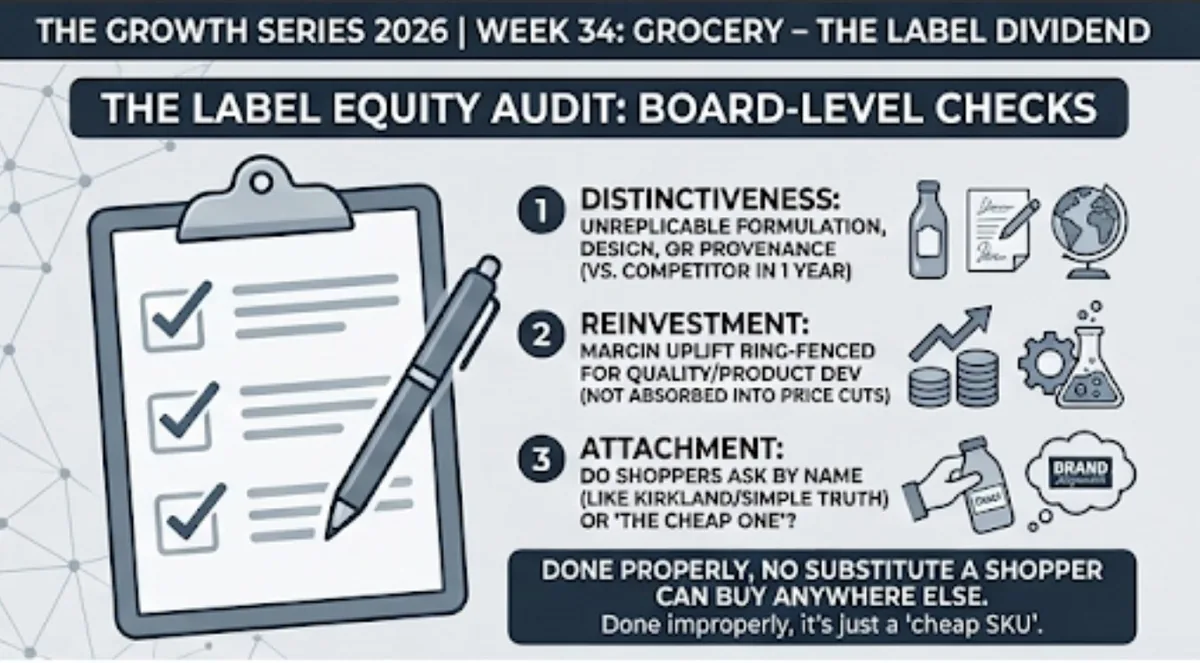
The Label Equity Audit
Three board-level checks before treating a private label range as a strategic asset rather than a defensive price play:
1. Distinctiveness: Could a competitor recreate this range, sourcing and all, inside a year? Or does it carry a formulation, design, or provenance a shopper would seek out by name?
2. Reinvestment: Is the margin uplift from this range being reinvested into quality and product development, or fully absorbed into headline price cuts?
3. Attachment: Do shoppers ask for the label by name, the way they ask for Kirkland or Simple Truth, or is it only ever recognised as “the cheap one”?
A range that fails all three is a discount SKU wearing a brand name. A range that passes all three is a brand the retailer owns outright, and very often the only one in the store it does.
The Audit is not a call to slow down. PLMA – Private Label Manufacturers Association mid-2026 data, drawn from Circana, put US store brand unit share at a record 23.8 percent, with shoppers saving 17 percent at checkout on average versus the national brand equivalent. But it is a call to be honest about the base you are growing from. Acosta Group analysis found national brands still hold a 76 percent average dollar share over the past five years, with higher household penetration and higher spend per trip than private label. Private label is winning the count; it has not yet won the wallet. That gap is exactly where the Label Equity Audit earns its keep, because #Distinctiveness and #Attachment are what close it, not another round of price cuts.
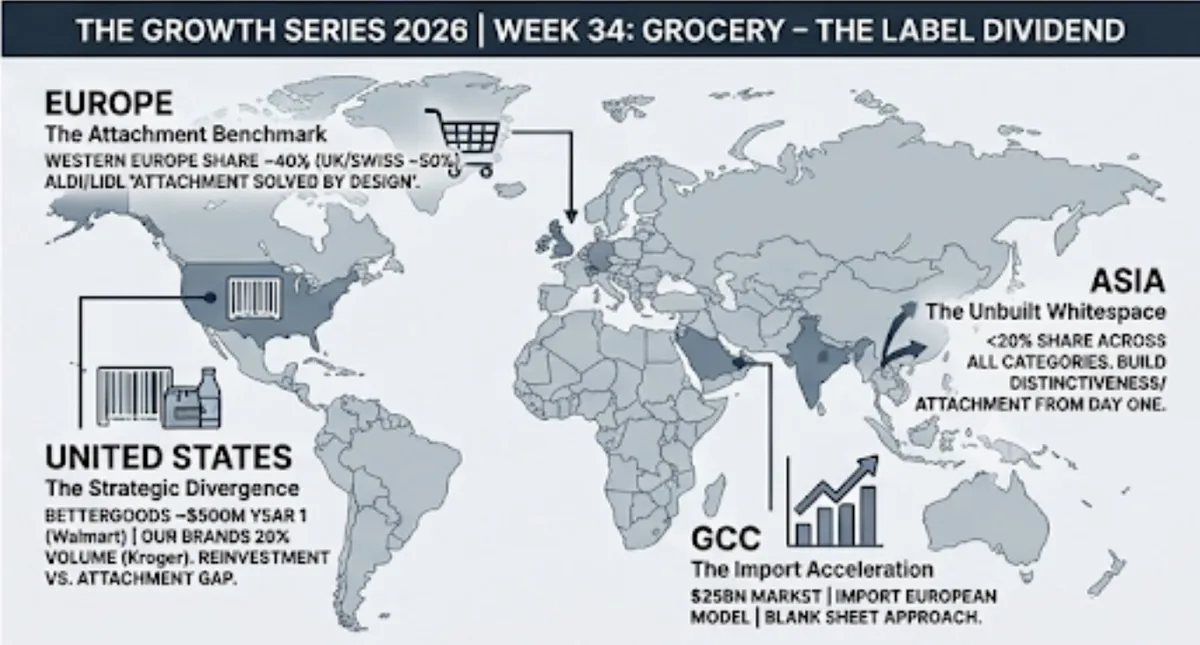
The Four-Lens Regional Framework
Europe (The Attachment Benchmark): Europe remains the global standard. NIQ puts Western Europe’s private label share at ~40%, roughly double the US and Australia, with PLMA reporting UK and Swiss share approaching 50%. Having run Lidl’s GB and Irish businesses, I place #Aldi and #Lidl at the far end of the Attachment axis: shoppers do not trade down to the store brand; the store brand is the primary brand on offer. That is Attachment solved by design, not marketing.
United States (The Strategic Divergence): The US demonstrates the exact spread the Label Equity Audit separates. Walmart’s Bettergoods (~400 SKUs, ~$500M year-one sales) reached >20% household penetration with a ~40% repeat purchase rate. Kroger’s Our Brands matches Walmart at 26% of volume across 13,000 items and 35 manufacturing plants, with Simple Truth exceeding $3BN in sales. Both pass Reinvestment, but trail Aldi and Trader Joe’s on Attachment (~80% shelf share). The 26% vs. 80% gap defines the difference between a market-share tactic and a brand identity.
Asia (The Unbuilt Whitespace): Innova Market Insights confirms that no private label category in Asia currently holds a market share of 20% or more. In India, 56% of shoppers stated they are purchasing more store brands. Having built Star Bazaar’s own-brand participation from 4% to 38% inside two years, I view this shift as validated store reality. The whitespace allows Asian grocers to engineer Distinctiveness and Attachment from day one.
GCC (The Import Acceleration): The Middle East and Africa private label market is expanding rapidly toward an estimated $35BN milestone. Rather than developing multi-tier legacy private label over decades, GCC operators are actively importing the European discount attachment model, building modern owned-brand infrastructure from a blank sheet.
Case Studies
Walmart (Bettergoods): The premier execution of Sequencing from the Bailie Agility Framework. Roughly 400 curated SKUs generating ~$500M in sales with a ~40% repeat rate. Built on quality reinvestment rather than wholesale range dilution.
Kroger (Our Brands & Simple Truth): The scale benchmark. 26% of sales volume across 13,000 items supported by 35 internal manufacturing facilities. Simple Truth ($3BN+ sales) represents true Attachment where customers actively seek the brand by name.
ALDI USA & Trader Joe’s : The structural end-state. Private label commands ~80% of the shelf. Owned brand is not an operational initiative; it is the enterprise strategy.
From The Shop Floor: Operational Reality
“At Star Bazaar, the Tata-Tesco hypermarket business in India, I took own-brand participation from 4 percent to 38 percent in two years, as part of turning the business from loss-making and single-channel into a profitable, award-winning omnichannel retailer 2021 across food, fashion, and general merchandise. That was not a pricing exercise. It was building private label into a range shoppers chose on its own merits, which is the Attachment check in the Label Equity Audit, done a decade before I had a name for it.” — Martin Bailie
Reality Check: The 76% Dollar Share Reality
The upside case is structural: household budget scrutiny, elevated product quality, strong Gen Z adoption, and exclusive loyalty remain durable tailwinds.
However, boards must confront the downside reality: national brands are defending their positions with sharper pricing, accelerated innovation, and aggressive digital engagement. Acosta’s finding that national brands still command 76% of five-year dollar share proves that private label is winning the unit count, but has not yet secured the total wallet. Private label wins only where retailers build true Distinctiveness and Attachment; it loses ground whenever a product is treated as merely a cheaper knock-off of the national brand it copies.
Key Performance Indicators & Market Benchmarks
– US Private Label CPG Sales: $330BN | Source: Circana via PLMA- US Private Label Unit Share (H1 2026 Record): 23.8% | Source: Circana / PLMA
– Average Shopper Savings on Store Brands: 17% | Source: PLMA
– Western Europe Private Label Share: ~40% | Source: NIQ
– UK & Switzerland Private Label Share: ~50% | Source: PLMA
– Asia Private Label Share Ceiling: <20% across all categories | Source: Innova Market Insights – Walmart Bettergoods Year-One Revenue: ~$500M (40% repeat purchase rate) | Source: The Food Institute / Walmart Disclosures – Kroger Our Brands Volume Share: 26% (Simple Truth >$3BN) | Source: Numerator / Kroger
– Aldi / Trader Joe’s Shelf Share: ~80% | Source: Numerator
– National Brand Average Dollar Share: 76% (5-year average) | Source: Acosta
The 18-Month Board Take
0–6 Months (Run the Label Equity Audit): Audit every private label line. Any range failing Distinctiveness and Attachment simultaneously is a discount SKU wearing a brand name—reprice, redesign, or delist. (Owner: CMO / Chief Brand Officer)
6–12 Months (Establish a Formal Reinvestment Rule): Ring-fence a fixed percentage of private label margin uplift specifically for formulation and packaging innovation rather than absorbing it into headline price cuts. (Owner: CFO & CMO)
12–18 Months (Segment Attachment vs. Price Tiers): Categorize ranges deliberately between Attachment-driven destination brands and basic opening-price-point tiers, resourcing each with distinct capital allocations. (Owner: CEO & Board)

Week 32–35: The Executive Roadmap
Week 32: General Merchandise & Fulfilment – The Fulfilment Reckoning.
Week 33: Convenience & Emerging Markets – The Unbuilt Advantage.
Week 34: Grocery – The Label Dividend & The Label Equity Audit.
Week 35: Fashion & Apparel Sector Rotation – Sourcing
“Private label is not a discount lever a retailer pulls when national brands get expensive. It is the only brand relationship in the store a retailer owns outright.” — Martin Williams Bailie