



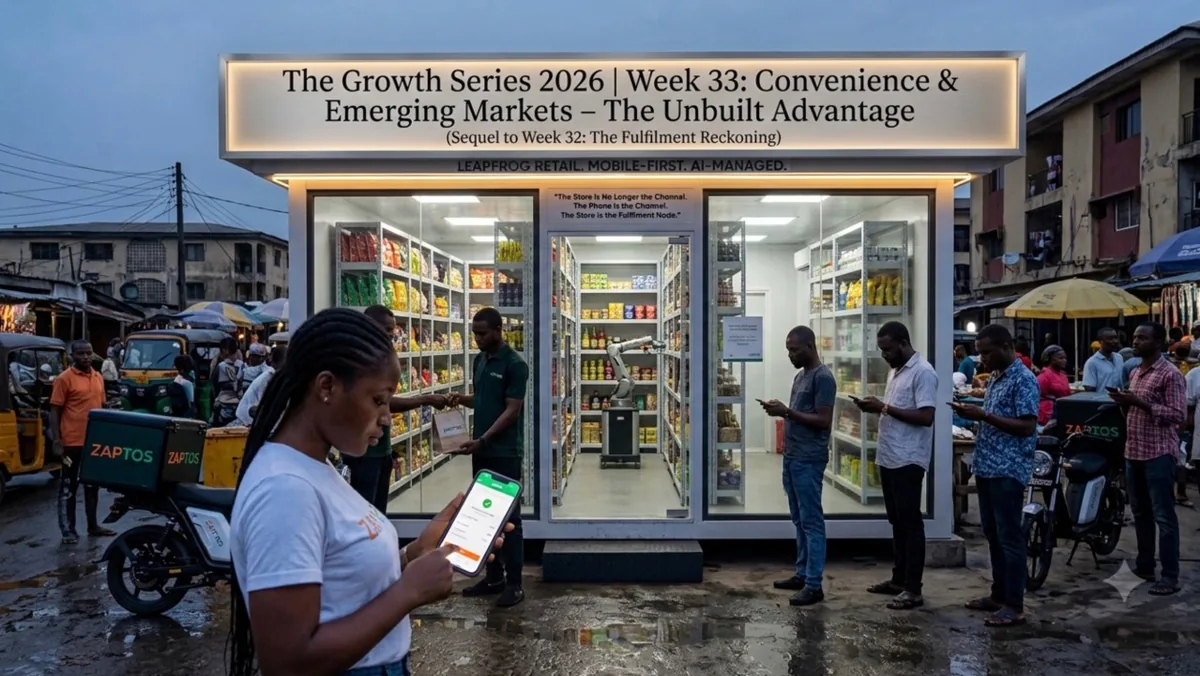
The Growth Series 2026 | Week 33: Convenience & Emerging Markets – The Unbuilt Advantage (Sequel to Week 32: The Fulfilment Reckoning)
Martin Bailie CEO & founder MWB advisory Ltd
The Growth Series 2026 | Week 33: Convenience & Emerging Markets – The Unbuilt Advantage (Sequel to Week 32: The Fulfilment Reckoning)
“The operators who never built legacy fulfilment infrastructure are no longer the students in this relationship. They are the teachers.” — Martin Bailie
Last week I wrote about the reckoning facing retailers who committed capital to fulfilment estate they can no longer justify. This week is about the operators who never built it, and who are now exporting their formats back into the markets that did.
Why This Is the Sequel, Not a New Subject
Week 32 made an argument about capital. The Fulfilment Reckoning was written for boards sitting on distribution networks and automation programmes that were signed off under demand assumptions which no longer hold, landing on a single discipline: proof before commitment. Simulate the investment before you sign the check, because the cost of finding out afterwards is now the highest cost in retail.
This week is the other half of that argument, and it is the more uncomfortable half. Because there is a category of retailer for whom proof before commitment was never a discipline they had to learn. They simply never had the capital to commit in the first place.
Those operators are no longer the students in this relationship. They are the teachers. The strategic question I would put to every board in Europe and North America reading this edition is not what should we do about emerging markets. It is: what have they built that we now have to import?
The Bailie Perspective

“I have run retail in both directions, and that is the only reason I am confident making this argument. I was COO of Lidl’s GB and Irish businesses and held board responsibility at Primark, which is about as deep inside the European operating model as it is possible to sit. I was then Managing Director and CEO of Star Bazaar, the Tata-Tesco hypermarket business in India. Same person, same instincts, two completely different sets of physics.
“What I got wrong in my first 6 months in India, including not planning for the Covid 19 outbreak, was assuming the sequencing would be the same. In Europe you build the estate, then you digitise it. That is not a strategy anyone chose—it is an accident of chronology: the stores were already there, so the technology had to be retrofitted onto them. In India the estate and the digital layer were being built in the same eighteen months, which meant we could design the operating model around the customer’s actual behaviour rather than around a property portfolio somebody signed in 1997.
“Star Bazaar went from loss-making and single-channel to a profitable omnichannel retailer in three years, with own-brand participation lifting from 4% to 38%. It was not merely a turnaround; it was a leapfrog, possible because there was less to unbuild.
“’Fresh Approach’ concept at Lidl Ireland- 2017 is the counter-example that proves the point. It was the first customer-centric store operating model in Lidl’s history and it nearly doubled our Irish market share. But the hardest part of that programme was the unbuilding: undoing a warehouse-led model that worked, that people were proud of, and that had thirty years of process wrapped around it.
“I am now advising on building discount retail in the emerging markets. What I am doing there is applying European discipline to a market that does not carry European drag. That combination is the whole thesis of this edition.” — MWB Advisory
The Unbuilt Advantage Audit (MWB Advisory Framework)
Before deciding how to commit capital, boards must decide whether they should be committing it at all, or importing a model from a market that already solved the problem without it. Run these three questions in your next strategy session:
1. #Legacy Drag: What share of your current fulfilment and store technology capex is maintaining an estate you would not build today if you were starting from a blank sheet? If your finance function cannot split maintenance of legacy from investment in future capability, you lack the information required to make a sound capital allocation decision.
2. #Skip Rights: Which upgrade steps can you skip entirely, rather than sequence? India’s quick-commerce networks skipped the hypermarket. Shoprite in Zambia skipped the card to go straight to mobile wallets. Skip rights are the single most valuable asset an under-built market has, and they expire the moment you build the legacy asset.
3. #Reverse Import: Which format, technology, or operating practice from your emerging market operations should you now be exporting into your developed markets? If a multinational’s answer is “none,” innovation is only permitted to travel downhill—a clear governance failure.
The Four-Lens Regional Framework
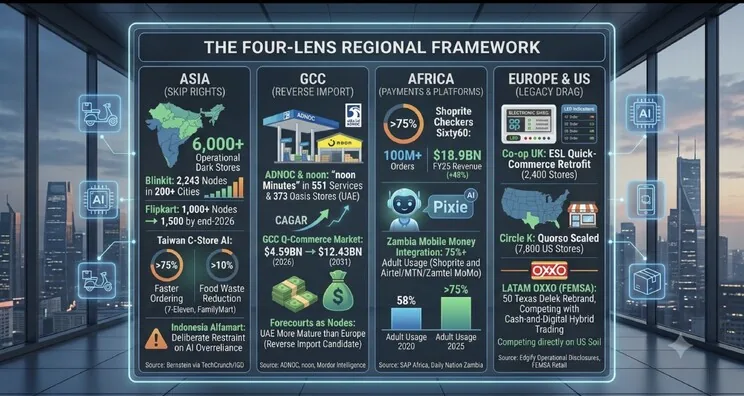
Asia (Skip Rights at National Scale):
India has built over 6,000 operational dark stores. Blinkit operates 2,243 micro-fulfilment centres across 200+ cities, while Walmart ’s Flipkart operates 1,000+ micro-nodes targeting 1,500 by end-2026. India built national micro-fulfilment density without first financing a legacy big-box estate. In Taiwan, 7-Eleven and FamilyMart Malaysia AI demand forecasting cuts ordering time by >75% and food waste by >10%. Indonesia’s Alfamart maintains deliberate restraint on AI overreliance.
GCC (Reverse Import Running Live):
ADNOC Distribution and noon have integrated “noon Minutes” fulfilment hubs inside 551 service stations and 373 Oasis stores across the UAE. The GCC quick-commerce market ($4.59BN in 2026) is expanding to $12.43BN by 2031 (22.05% CAGR). Forecourts as fulfilment nodes are more mature in the UAE than in Europe, representing a prime reverse import candidate.
Africa (Skip Rights in Payments & Platforms):
The Shoprite Group of Companies Checkers Sixty60 fulfilled 100M+ orders (FY25 revenue up 48% to R18.9BN) and launched ‘Pixie’ AI assistant in 2026. In Zambia, Shoprite fully integrated mobile wallets (Airtel Money, MTN MoMo, Zamtel Money) across its national footprint where adult mobile money usage passed 75%.
Europe & US (Legacy Drag & Reversal):
Co-op UK is retrofitting Vusion electronic shelf labels across 2,400 stores to double as quick-commerce picking indicators. Circle K scaled Quorso across 7,800 US stores. Crucially, Latin American convenience leader OXXO (FEMSA, 22,700+ stores) rebranded 50 former Delek stores in Texas. A Latin American operator built for cash-and-digital hybrid trading is now competing directly on US soil.
The Silicon Layer: Where This Becomes a CFO Problem
Scaling in-store AI brings a massive, unmodeled cost line. A single self-checkout camera streaming 1080p video to a cloud server generates ~50GB of egress data daily. Across 4 lanes and 12,000 stores, data volumes reach petabyte-per-day scales.
Edgify ‘s edge-first architecture processes inference locally on $300 in-store POS hardware, running across 8,000+ devices in 12 countries. Similarly, Supermicro and NVIDIA launched in-store Blackwell GPU infrastructure at #NRF2026.
Edge-first architecture is not primarily about privacy; it is about operating profitably at high store counts with thin margins and unreliable connectivity. The edge architecture pioneered under emerging market constraint is the exact architecture Western incumbents require to protect operating margins.
Key Performance Indicators & Market Benchmarks
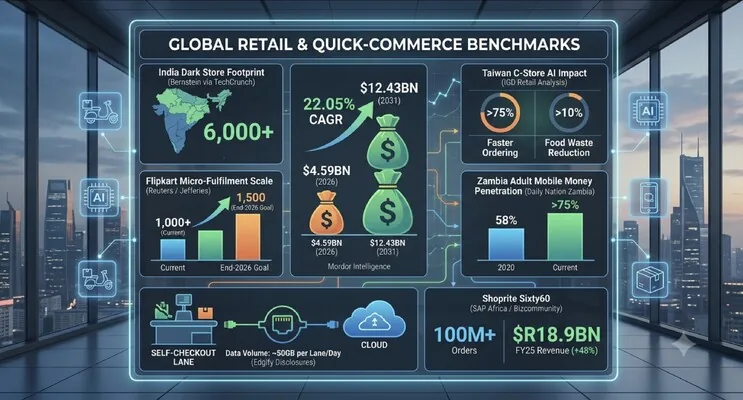
India Dark Stores in Operation: 6,000+ active dark stores national footprint | Source: Bernstein via TechCrunch
Flipkart Micro-Fulfilment Scale: 1,000+ nodes scaling to 1,500 by end-2026 | Source: Reuters / Jefferies
GCC Quick-Commerce Market (2026–2031): $4.59BN → $12.43BN (22.05% CAGR) | Source: Mordor Intelligence
Taiwan C-Store AI Impact: >75% faster ordering, >10% food waste reduction | Source: IGD (Institute of Grocery Distribution) Retail Analysis
Zambia Adult Mobile Money Penetration: >75% (up from 58% in 2020) | Source: Daily Nation Zambia
Self-Checkout Cloud Egress Volume: ~50GB per lane per day | Source: Edgify Operational Disclosures
Shoprite Sixty60 Volume: 100M+ orders; R18.9BN FY25 revenue (+48%) | Source: SAP Africa Code Week / Bizcommunity.com
The 18-Month Board Take
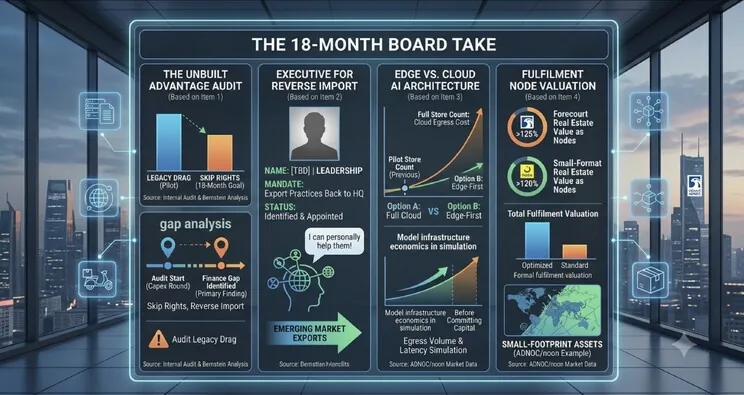
1. Run the Unbuilt Advantage Audit Before Your Next Capex Round: Audit legacy drag, skip rights, and reverse import. If finance cannot produce the legacy maintenance number within two weeks, that gap is your primary finding.
2. Appoint a Named Executive to Own Reverse Import: Assign a single leader with a clear mandate to identify practices in your emerging market operations and export them back to headquarters. (Reach out for my help too !)
3. Resolve Edge vs. Cloud AI Architecture Before Scaling: Model the cloud egress cost at full store count, not pilot store count. Prove the infrastructure economics in digital simulation before committing capital.
4. Value Forecourt & Small-Format Real Estate as Fulfilment Nodes: Put a formal fulfilment valuation on small-format real estate. ADNOC Group and noon prove what small-footprint assets are worth when executed properly. NACS
Week 31–34: The Executive Roadmap

Week 31: Fashion & Apparel – The Elevation Mandate.
Week 32: General Merchandise & Fulfilment – The Fulfilment Reckoning.
Week 33: Convenience & Emerging Markets – The Unbuilt Advantage.
Week 34: Grocery Sector Rotation – Advanced Supply Chain Autonomy.
“The operators who never built legacy fulfilment infrastructure are no longer the students in this relationship. They are the teachers.” — Martin Bailie