



The Growth Series 2026 | Week 30: Grocery & The Basket Autonomy Era – Winning the Agentic Recommendation Layer
Martin Bailie CEO & founder MWB advisory Ltd
“The grocery basket used to be built by a shopper walking a store. This year it’s being built by an agent reading a fridge. The retailers winning the next five years aren’t the ones with the best app—they’re the ones whose inventory, pricing, and fulfilment can be trusted by a machine acting on a customer’s behalf.” — Martin Bailie
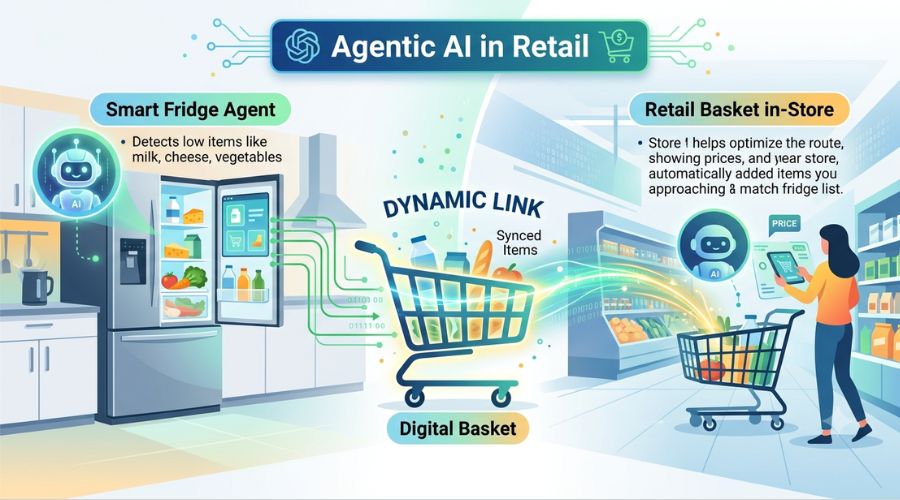
We have explored the high-yield monetisation models within convenience and pharmacy, and weaponised first-party customer records across volatile retail categories. Now, we confront the absolute core of high-volume retail: The Basket Autonomy Era. When I examine executive boardrooms across global grocery networks, the most urgent debate has moved past whether artificial intelligence belongs in a front-end customer app or the back office. What is live right now across Kroger , Walmart , Tesco , and Carrefour is agentic commerce—autonomous systems that do not merely suggest a recipe or recommend a product, but actively execute purchases, verify real-time inventory, build the basket, and complete the transaction on behalf of the consumer.
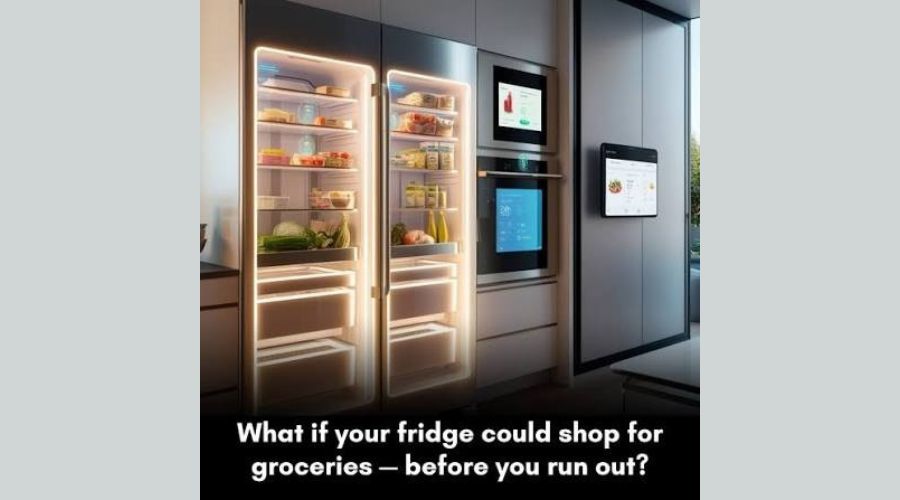
The grocery basket used to be built by a shopper walking a physical store floor; today, it is increasingly constructed by an autonomous agent reading a smart appliance or analysing historical consumption data. The retailers winning the next five years are not those with the most decorative mobile app, but those whose real-time inventory accuracy, regional pricing integrity, and fulfillment logistics can be completely trusted by a machine acting on a consumer’s behalf. The hard truth for executive leadership is that market share and AI visibility have begun to diverge sharply. If a growing percentage of grocery discovery routes through an AI recommendation engine rather than a traditional search results page or endcap display, that visibility gap represents a structural leak every board must track with the same discipline as like-for-like sales.
The Bailie Diagnosis

“My diagnosis from running large-scale operations—including my time as CEO of Tesco Tata India, Chief Operating Officer at Lidl UK/IE, and serving on the Primark board—is clear: the hardest, most lasting commercial transformations are never the ones with a flashy front-end interface. They are the ones that touch the supply chain’s nervous system—demand forecasting, dynamic replenishment, and absolute price integrity. In high-volume, lean-margin environments like discount retail, replacing legacy spreadsheet-driven forecasting with dynamic, real-time data simulations eliminates the hidden P&L drag of overstocking and systemic operational waste.
“Kroger’s strategic pivot away from capital-heavy, robotic micro-fulfilment centres toward agentic software tools built on Google ‘s Gemini Enterprise platform is a massive industry tell. The smart capital is moving away from concrete and conveyor belts toward software intelligence that sits directly on top of your existing store estate. If your inventory accuracy and regional pricing data are not structured for direct machine consumption, physical scale alone will not prevent your brand from becoming invisible to the autonomous consumer.”
Four-Lens Regional Framework
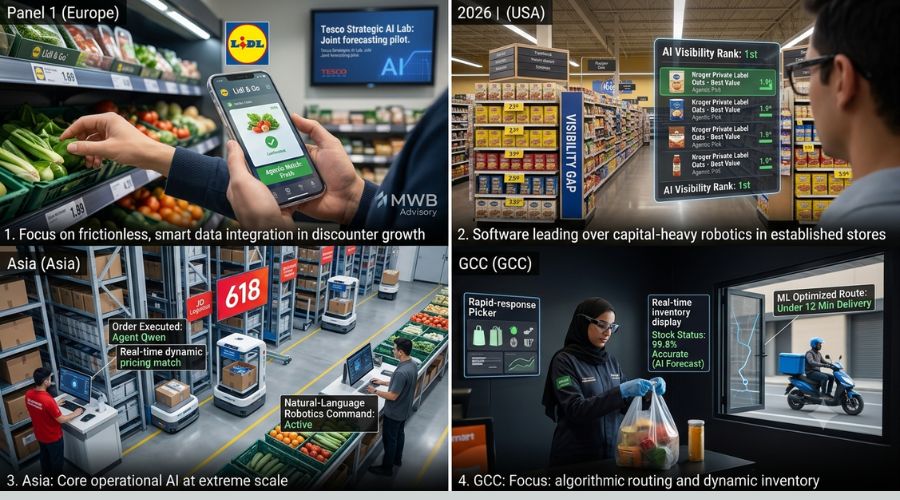
Europe (Strategic Custom Labs & Smart Discounter Scale):
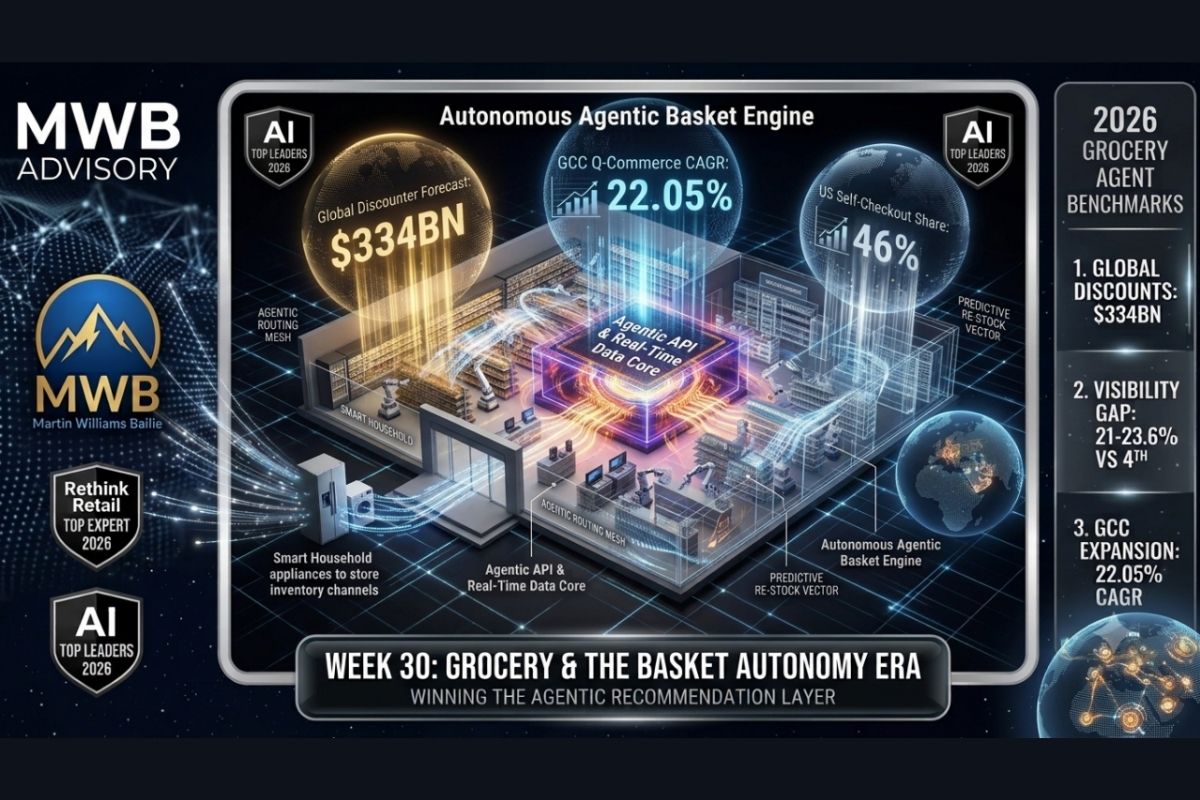
Tesco has shifted its AI focus toward a three-year strategic partnership with Mistral AI to build custom demand forecasting, Clubcard personalisation, and operational automation via a joint ‘AI lab’. Carrefour demonstrated agentic meal-planning flows via ChatGPT that check live inventory to assemble full baskets automatically. Structurally, IGD (Institute of Grocery Distribution) forecasts the UK grocery market reaching £297 billion by 2030 (3% CAGR), with discounters Lidl GB and Aldi UK projected to reach $334 billion in combined global sales by 2030, accelerated by private-label investments, ‘Lidl & Go’ self-scan expansions, and retail media infrastructure.
United States (The Visibility Gap & Workforce AI):
Kroger’s pivot from robotic centralised fulfillment toward agentic commerce—formalised via an expanded Google Cloud Partners partnership and a newly appointed Chief Data & AI Officer—marks a decisive shift toward software-led capital efficiency. Walmart is deploying internal AI assistants (such as ‘Wally’ for merchandising and pricing) directly into its workforce. However, 5WPR’s 2026 US Grocery Retail AI Visibility Index reveals a stark disconnect: despite Walmart holding roughly 21–23.6% of total US grocery spend, it ranks fourth in AI citation share behind Costco Wholesale , Trader Joe’s , and Whole Foods Market .
Asia (Core Operational AI & High-Density Robotics):
During China’s mid-2026 618 shopping festival (generating 934 billion CNY in GMV), AI sat directly at the center of automated product matching, dynamic pricing, and delivery logistics. Alibaba.com hardwired its Qwen model into the Wanxiang engine, while JD.COM deployed its Jingxiaotong system across logistics and media. JD Logistics utilises roughly 3,600 warehouses—including partner ‘cloud’ sites—where the ‘Zhilang’ platform pairs vertical storage with handling robots to dramatically exceed manual picking throughput.
GCC (Quick-Commerce & Algorithmic Routing):
The GCC quick-commerce market is expanding rapidly, projected by Mordor Intelligence to grow from $4.59 billion in 2026 to $12.43 billion by 2031 (a 22.05% CAGR), with staples commanding over half the market. Majid Al Futtaim’s Carrefour operates 24/7 express delivery in Dubai across 10,000 SKUs. AI drives the back-end: real-time forecasting has slashed stockouts for platforms like talabat mart , while machine-learning routing has reduced delivery times in Riyadh and Dubai to under 12 minutes.
World-Class Execution: World-Class Case Studies
Kroger (From Concrete to Code):
Reallocated capital away from capital-intensive centralise robotic fulfilment toward agentic commerce platforms on Google Cloud’s Gemini Enterprise, establishing dedicated executive AI leadership under Milen Mahadevan.
ALDI USA (Expansion Meets Rebuilt Digital Rails):
Executing an expansion of over 180 store openings across 31 states by the end of 2026, while simultaneously rebuilding its digital stack on Instacart’s Storefront Pro platform to unify e-commerce, mobile, and store operations.
Amazon (Natural-Language Robotics at Scale):
Unveiled its next-generation Proteus robot, capable of receiving natural-language commands directly from warehouse staff without complex technical interfaces, backed by a €10 billion European fulfillment modernisation plan.
The Executive Grocery Benchmarks
Global Discounter Combined Revenue ($334BN):
The 2030 projected global sales milestone for Lidl and Aldi, driven by private-label expansion and lean, high-velocity operating models.
US Retail Self-Checkout Share (46%):
Capital One Research benchmark confirming the heavy consumer adoption of automated checkout lanes across US retail footprints.
GCC Quick-Commerce Growth Rate (22.05% CAGR):
The accelerated trajectory of hyper-local delivery networks expanding to $12.43 billion by 2031.
Impact Thinking: The 18-Month Board Take
“First, agentic commerce must transition from a pilot program into a standing P&L line item: expect procurement and merchandising teams to track AI-agent-influenced basket share as a core KPI.
Second, the structural advantage of discount retail will consolidate further—IGD’s projected 4.8% CAGR for discounters represents a fundamental repricing of fair value that full-service grocers cannot ignore.
Third, AI visibility must become a standing board-level metric alongside market share. Dominating physical store count while remaining invisible to AI recommendation agents is a structural vulnerability no modern grocer can afford.” MWB Advisory
Week 27–31: The Executive Roadmap
Week 27: The Convenience Channel – Micro-Format Growth and Out-of-Home Calories.
Week 28: Fashion’s Data Dividend – First-Party Personalisation at Scale.
Week 29: Pharmacy & Health Retail – The Next Retail Media Frontier.
Week 29 Bonus: The Future Qualities of Leadership – A CHRO’s View.
Week 30: Grocery & The Basket Autonomy Era – Winning the Agentic Recommendation Layer.
Week 31: Fashion & Apparel Sourcing Volatility – Special Edition.
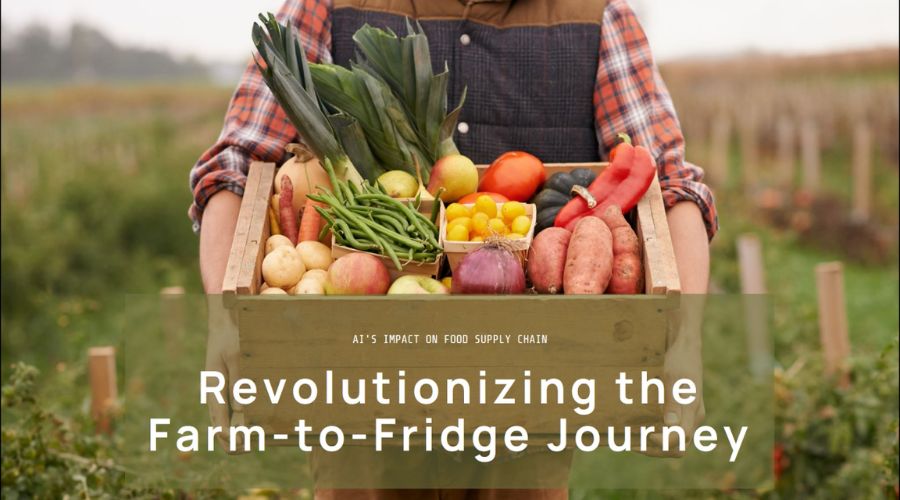
“The grocery basket used to be built by a shopper walking a store. This year it’s being built by an agent reading a fridge. The retailers winning the next five years aren’t the ones with the best app—they’re the ones whose inventory, pricing, and fulfilment can be trusted by a machine acting on a customer’s behalf.” — Martin Bailie