



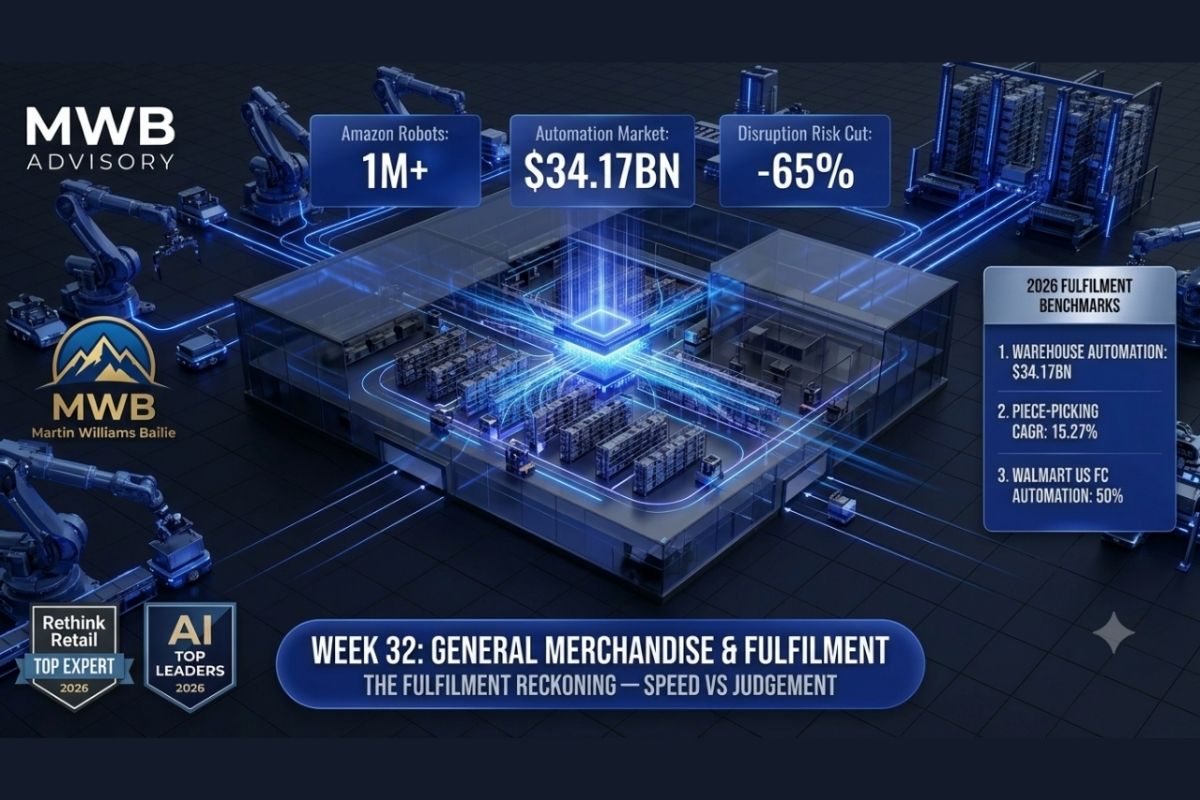
The Growth Series 2026 | Week 32: General Merchandise & Fulfilment – The Fulfilment Reckoning
Martin Bailie CEO & founder MWB advisory Ltd
“For twenty years the industry measured fulfilment by speed. That era is closing. The next decade will be won by retailers who fulfil with judgement — deploying automation where it earns its keep, and holding the line where the human edge still decides the sale.” — Martin Bailie
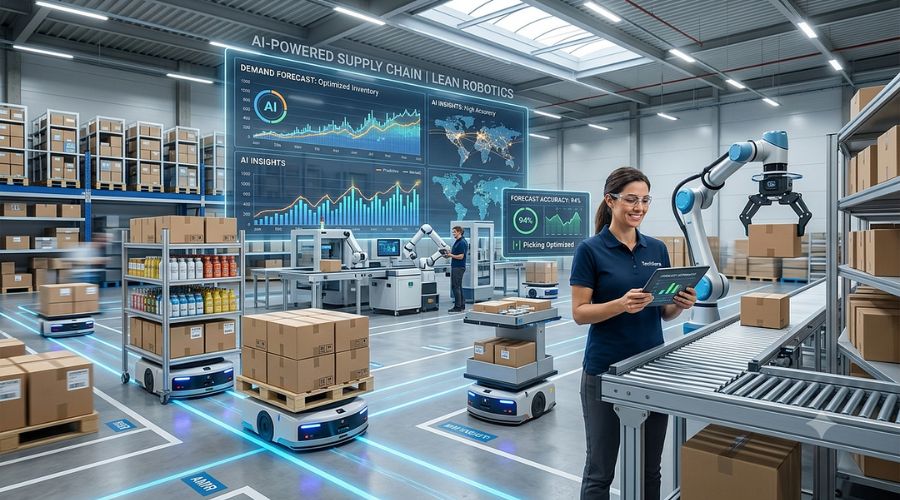
General merchandise and fulfilment is the vertical where the industry’s artificial intelligence spend becomes physical. This week isn’t about dashboards or copy generation—it’s about robots on the floor, capital committed in the billions, and boards deciding, in real time, how much of their operating model they are willing to automate.
Three numbers set the frame:
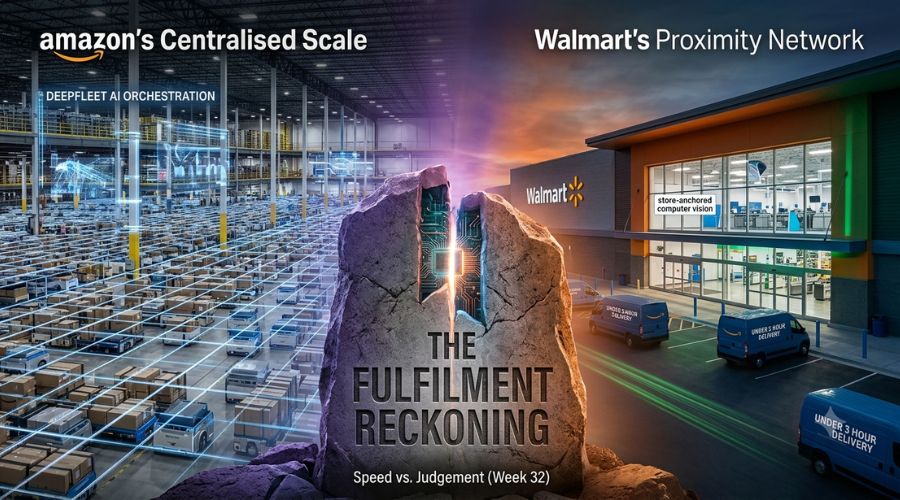
Amazon Business has now deployed over one million robots across its fulfilment network and is guiding to roughly $200 billion of 2026 capital expenditure spanning AI infrastructure, chips, robotics, and fulfilment assets—with a further €10 billion committed to modernising its European network alone.
Walmart has taken a different route to a similar destination. At Walmart US, half of e-commerce fulfilment centre volume is already automated, sixty percent of stores now receive automated freight, and computer vision-driven proximity fulfilment delivered thirty-five percent of store-fulfilled orders in under three hours last quarter. CFO John David Rainey has told investors the business is “hitting the peak” of annual automation spending.
The global warehouse automation market stands at USD 34.17 billion in 2026, growing at a 13.98% CAGR to reach USD 65.74 billion by 2031, with piece-picking robotics forecast to grow fastest of all at over 15% CAGR.

The Bailie Diagnosis:
“For twenty years the industry measured fulfilment by speed. That era is closing. The next decade will be won by retailers who fulfil with judgement—deploying automation where it earns its keep, and holding the line where the human edge still decides the sale.” — Martin Bailie
I don’t watch this vertical from the outside. I came up through the warehouse floor. As COO at Lidl UK/IE and later as CEO across Tesco and Tata’s retail operations, efficiency, semi-automation, and full automation were my direct remit—not a slide someone else presented to me. I built and opened advanced distribution centres across the last decade of my operating career, and I sat through every stage of that journey: the manual-to-semi-automated business case, the capital committee that wanted certainty before it would sign, and the eighteen months of disruption that no vendor deck ever fully prepares you for.
When I evaluate the central tension between Amazon’s centralised robotic scale and Walmart’s store-anchored proximity fulfilment, my position is unequivocal: for most general merchandise networks, proximity beats warehouse density every time. Building capital-intensive mega-hubs works when you hold Amazon’s scale, but for traditional multi-banner operators, tying static automation to volatile SKU profiles is a massive capital risk.
Here is where I extend supply chain strategist Brittain Ladd’s thesis into general merchandise: micro-fulfilment is not equipment you install, but a network and real-estate strategy you commit to. Applied to general merchandise—where basket breadth, SKU proliferation, and unpredictable demand spikes make static automation dangerous—treating micro-fulfilment as a technology purchase rather than an estate decision is the single fastest way to blow out a capital budget.
The Four-Lens Regional Framework
Europe (Store Automation & Store-Level Execution): Amazon ‘s €10 billion commitment to modernising European fulfilment with robotics signals a direct response to rising labour costs and maturing same-day expectations across the UK, Germany, and France. Beneath hyperscaler headlines, European general merchandisers are automating the store itself. Vusion electronic shelf label and retail IoT infrastructure enable dynamic pricing and stock accuracy. Meanwhile, Quorso ‘s Intelligent Management Platform (live across 50,000+ stores including Currys and Avolta) delivers vendor-disclosed gains of 50 to 150 basis points in sales and a 25 to 40 basis point reduction in shrink.
United States (The Proximity vs. Density Battle): The US is where the robotics race is most contested. Amazon’s DeepFleet generative AI model coordinates robot movement across its network, improving fleet travel time by 10%. Walmart responds by competing on store proximity, leveraging computer vision for real-time inventory mapping. Meanwhile, Kroger ‘s tie-up with automated micro-fulfilment provider Fulfil shows micro-fulfilment spreading beyond the two giants into grocery-adjacent general merchandise.
Asia (Embodied Intelligence & High-Throughput Density): China is executing aggressive fulfilment automation. JD.COM chairman Richard Liu stated that robots will “sooner or later” replace the company’s 700,000 delivery workers, pursuing a three-stage roadmap (digital, attached, embodied intelligence). Syntun’s 618 festival monitoring recorded JD Logistics and SF Holding operating high-density automated fulfilment as the invisible backbone of China’s agentic commerce boom.
GCC (Compute Infrastructure Ahead of Use Cases): The GCC story is being written at the infrastructure layer. Saudi Arabia’s HUMAIN and the UAE’s Stargate data-centre project (backed by G42, Nvidia, Microsoft, OpenAI) are building compute foundations for demand forecasting and robotics coordination. IBM Research reveals 77% of UAE senior leaders reporting significant productivity gains from AI, with 92% expecting agentic AI to deliver measurable ROI within two years.
Named Execution Case Studies
Amazon (DeepFleet & The Million-Robot Network): DeepFleet orchestrates an expansive fleet using generative AI to extract an additional 10% efficiency gain from already-deployed assets, proving the next automation frontier is coordination software, not just hardware.
Walmart (Computer Vision as a Proximity Strategy): Bet on store-network proximity and real-time computer-vision inventory mapping rather than warehouse robot density alone.
Kroger & Fulfil (Micro-Fulfilment Playbook): Scaling automated micro-fulfilment from single-site experiments into a repeatable, vendor-backed operational playbook.
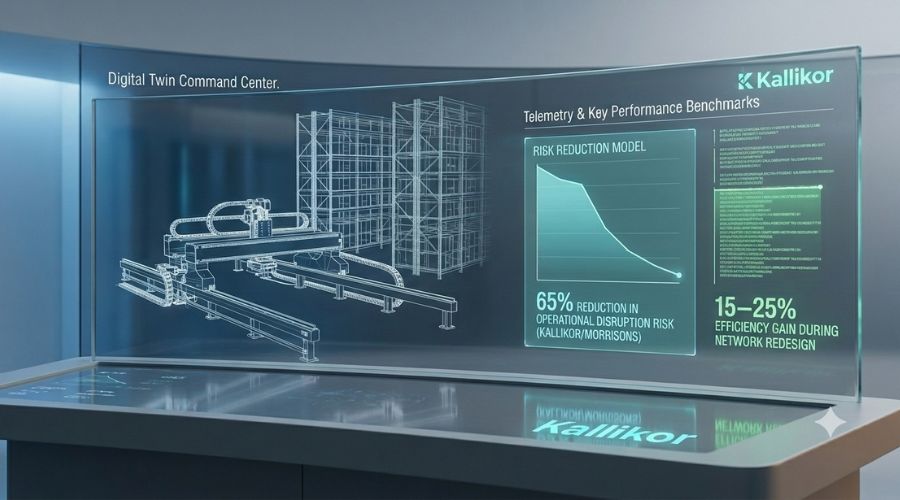
Kallikor & Morrisons (The Business Case Before Capital): Kallikor’s Adaption platform creates a full digital twin of a retailer’s supply chain. Morrisons uses Adaption to model its logistics network across 500 supermarkets and 1,700 convenience stores, achieving up to a 65% reduction in operational disruption risk and 15–25% efficiency gains before committing capital. While Nvidia’s Omniverse/Isaac platforms target robotics developers (e.g., GXO, KION Group), Kallikor provides an accessible simulation layer specifically for operating committees.
Reality Check: Economic Friction & Speed Realities
Warehouse automation spending is accelerating, but Swisslog ‘s 2026 supply chain outlook notes that tariffs and economic uncertainty are forcing general merchandisers to hold flexible, uncommitted inventory positions—complicating fixed automation business cases. Furthermore, reporting indicates Amazon is targeting automation of up to 75% of operations, potentially reshaping over half a million roles and intensifying public-policy debate.
Crucially, speed is losing its status as the sole differentiator. Multiple 2026 supply chain analyses confirm that under consumer spending pressure, ultra-fast fulfilment matters less to loyal general merchandise customers than brand trust, seamless returns, and clear value-adds—challenging the decade-long obsession with next-day delivery as the primary competitive lever.
Key Performance Indicators & Market Benchmarks
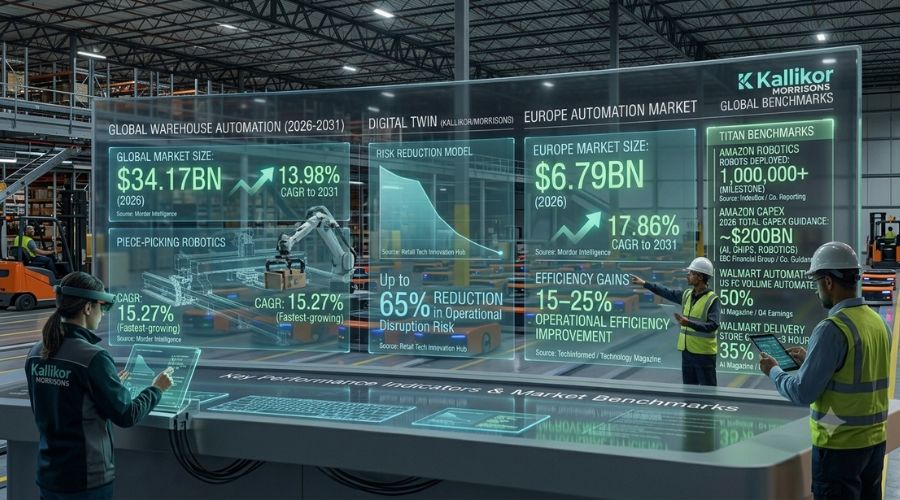
Global Warehouse Automation Market Size: $34.17BN in 2026 (13.98% CAGR to 2031) | Source: Mordor Intelligence
Piece-Picking Robotics CAGR: 15.27% (Fastest-growing segment) | Source: Mordor Intelligence
Amazon Robots Deployed: 1,000,000+ milestone crossed | Source: Company reporting via IndexBox
Amazon 2026 Total Capex Guidance: ~$200BN (AI, chips, robotics, fulfilment) | Source: Company guidance via EBC Financial Group
Walmart US FC Volume Automated: 50% | Source: AI Magazine / Walmart Q4 Earnings
Walmart Store Orders Delivered <3 Hours: 35% | Source: AI Magazine / Walmart Q4 Earnings
Europe Warehouse Automation Market: $6.79BN in 2026 (17.86% CAGR to 2031) | Source: Mordor Intelligence
Digital Twin Risk Reduction (Kallikor/Morrisons): Up to 65% reduction in operational disruption risk | Source: Retail Tech Innovation Hub
Digital Twin Efficiency Gains (Kallikor/Morrisons): 15–25% operational efficiency improvement | Source: TechInformed / Technology Magazine
The 18-Month Board Take
1. Treat Micro-Fulfilment as a Network & Real Estate Decision:
Before signing an automation vendor, mandate a joint property, labour, and technology business case. General merchandise’s SKU breadth makes equipment-first decisions far more expensive to unwind than in grocery.
2. Fund Coordination Software Before Adding Hardware:
Amazon’s DeepFleet results prove that the highest near-term ROI sits in orchestration software over existing fleets rather than buying additional robots.
3. Rebalance Customer Promises from Speed to Trust:
Redirect a portion of automation-linked marketing spend toward returns policy, loyalty, and brand equity—measuring it with the same discipline as delivery-time KPIs.
4. Build the Business Case via Digital Twins Before Spending Capital:
Leverage synthetic digital twin simulation (like Kallikor’s Adaption) to stress-test automation roadmaps. Building an automation business case from static spreadsheets and vendor promises introduces unnecessary capital risk.

Week 29–33: The Executive Roadmap
Week 29: Pharmacy & Health Retail – The Next Retail Media Frontier.
Week 30: Grocery & The Basket Autonomy Era – Winning the Agentic Recommendation Layer.
Week 30 Bonus: UK Retail – State of the Nation.
Week 31: Fashion & Apparel – The Elevation Mandate.
Week 32: General Merchandise & Fulfilment – The Fulfilment Reckoning.
Week 33: Convenience & Emerging Markets – The Micro-Format Frontier.