



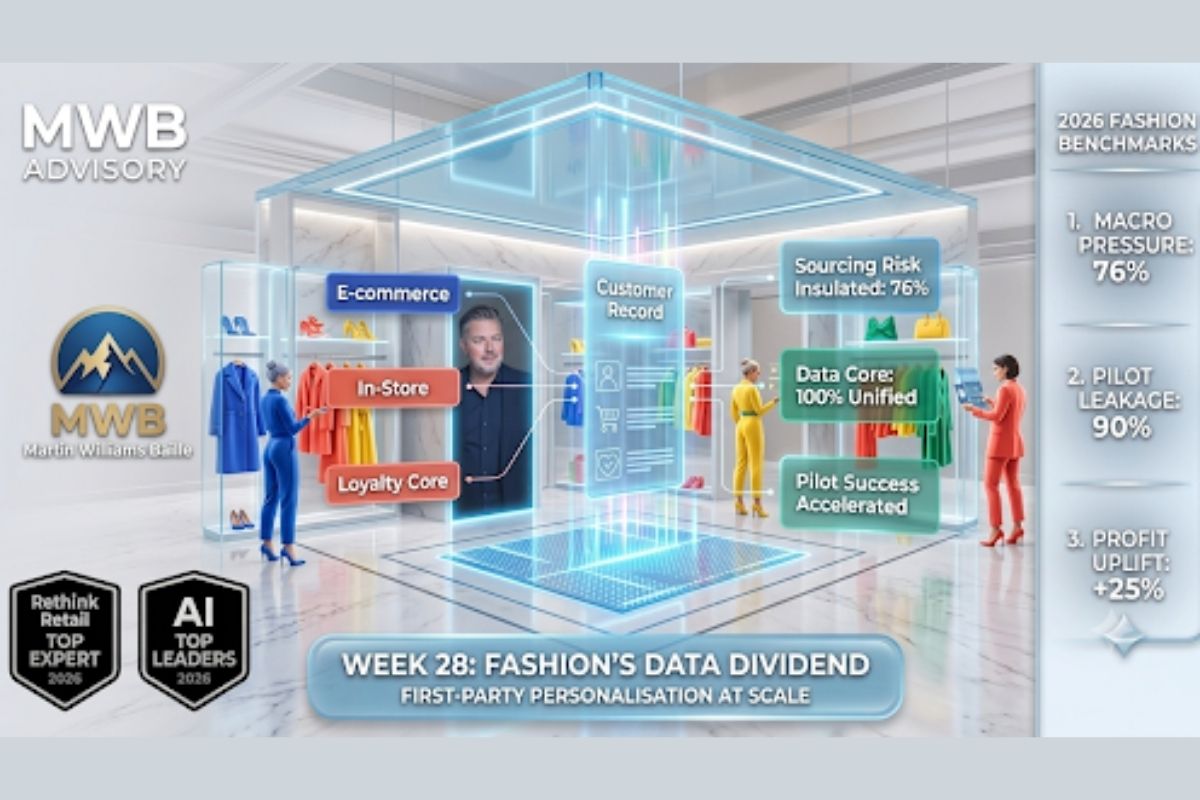
The Growth Series 2026 | Week 28: Fashion's Data Dividend – First-Party Personalisation at Scale
Martin Bailie CEO & founder MWB advisory Ltd
"Fashion has spent a decade chasing the trend cycle. The brands that win 2026/27 will be the ones who stop chasing only trends and start owning their customer's data instead—because in a tariff-hit market, the data is the only margin lever left that a government can't touch.
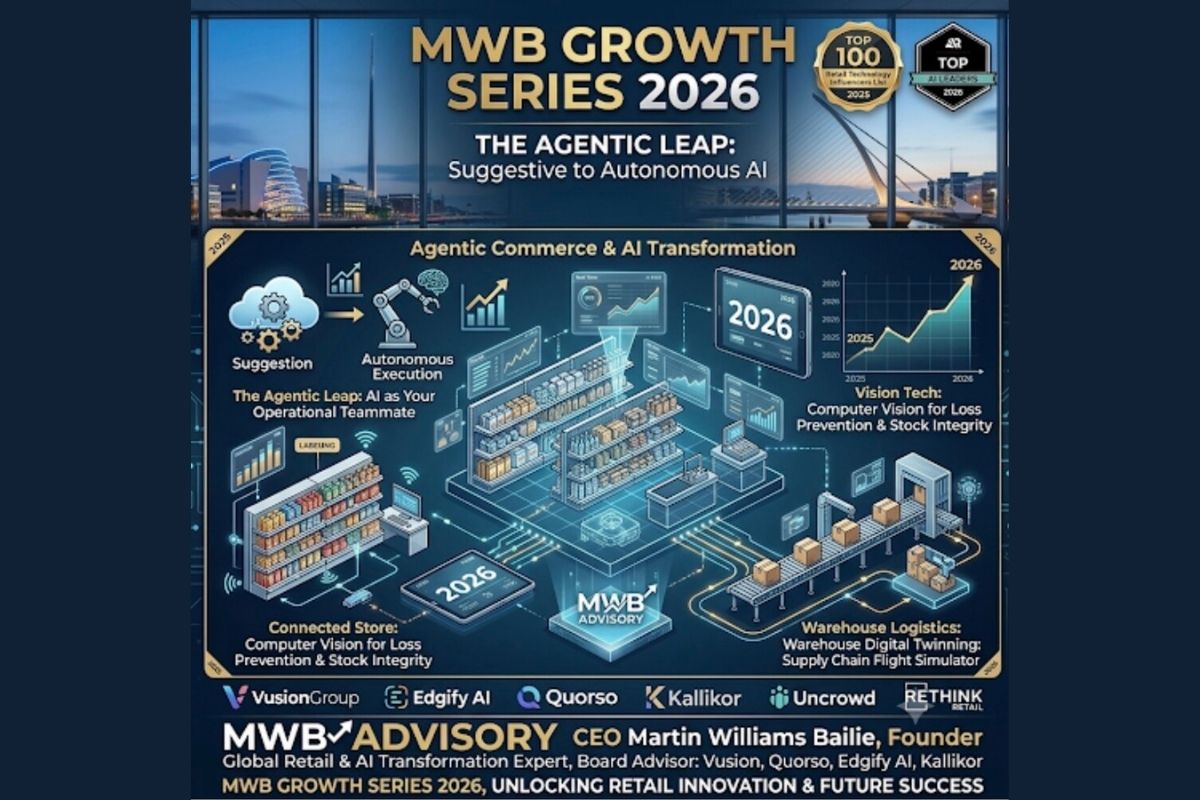
We have broken down the convenience format, monetised the immediate transaction window, and proven that the physical storefront must act as a quick-service destination.
Now, we confront the structural, macroeconomic volatility reshaping the global apparel landscape:
Fashion’s Data Dividend. When I examine international apparel operations, the strategic flaw I witness most often is a total reliance on outward-facing trend cycles rather than inward-facing data ownership.
Fashion has spent a decade chasing short-term viral loops. The brands that win 2026/27 will be those that stop chasing external trends and start owning their customer data instead. In a tariff-hit market, clean first-party data is the only structural margin lever left that a government cannot touch.
The backdrop for this shift is uncompromising. The latest The Business of Fashion – McKinsey & Company State of Fashion 2026 survey establishes that tariffs have surged to the absolute number-one issue on the minds of fashion executives—with 76 percent citing it as the defining hurdle of the year.
Nearly half—46 percent—explicitly expect macro conditions to get worse before they get better. Yet, buried deeper within that exact same data lies the real operational opportunity: fashion leaders simultaneously rank artificial intelligence as their single largest opportunity for 2026.
Hyper-personalisation stands at the absolute sharp end of this technological pivot, extending all the way to autonomous, agentic shopping assistants that understand a user’s size, style profile, and historical parameters well enough to execute purchasing decisions on their behalf
The Bailie Diagnosis

“My diagnosis for apparel boards is stark: your artificial intelligence ambitions are being built directly on broken foundations. While executive teams celebrate the promise of agentic commerce, the unglamorous truth is that up to 90 percent of AI initiatives in the fashion sector fail to scale past the initial pilot phase. This systemic leak does not happen because the algorithms are flawed; it happens because your underlying customer data is too fractured, siloed, and messy to support them.
“I have championed this core operational principle for years across international supply chains, and it remains absolute in fashion: the enterprises with true, unified visibility into their data infrastructure—who can simulate what-if scenarios before the macroeconomic shock lands—are the ones who weaponise volatility into a competitive dividend.
Tariffs are simply this season’s stress test. Your first-party data core is the only buffer capable of protecting the P&L from external pricing erosion.” Martin Bailie

Global Frameworks: Navigating Regional Retail Realities
The race to secure the first-party data dividend is moving at entirely different speeds across global borders:
United States (The Tariff Epicentre): Facing immediate, direct structural exposure to shifting trade routes and trade disputes. With consumer sentiment highly sensitive to pricing turbulence, top-tier US operators are aggressively using unified loyalty footprints as a margin defensive wall, shifting completely away from margin-eroding public markdowns toward targeted, private algorithmic incentives
Europe (The Compliance and Assortment Squeeze): Confronting intense legislative pressures around leftover inventory alongside traditional value-seeking consumer shifts. Leading European brands are utilising first-party predictive modeling to radically simplify their upfront collections, ensuring inventory profiles map directly to verified customer history to prevent regulatory waste penalties.

Asia (The Agentic Pioneer): Operating in a highly integrated digital ecosystem where consumers already delegate discovery entirely to large language models and assistant interfaces. Sourcing and planning data are structurally combined with front-end transactional engines, allowing AI to handle upstream capacity decisions and localized trend response in near real-time
GCC (The Premium Clienteling Benchmark): Focusing heavily on the strategic renewal of the luxury and premium tiers through deep, data-driven trust. Retailers are leverageing clean customer files to empower physical store associates with predictive styling tools, driving high-ticket basket values and protecting full-price terminal margins.
World-Class Execution: The Data Foundations
Inditex (Zara): The ultimate operational standard for matching supply with volatile demand. By structurally linking physical shop-floor feedback vectors with automated manufacturing hubs, they de-risk the trend cycle, reducing inventory carrying costs by up to 40% through precise local allocation.
Nike : Consolidates digital apps, global loyalty memberships, and physical flagship store interactions into one singular customer record. This unified first-party file dictates production forecasting and regional product drops, avoiding the classic retail inventory trap.
adidas : Successfully engineered an aggressive operational turnaround by radically simplifying assortments and pulling working capital directly out of dead stock. They achieve this by ensuring AI forecasting engines are fed exclusively by clean, structured first-party demand data.
The Executive Priorities: Three Moves Before End Of Q4
Unify the Triad Customer Record: Eradicating data silos by immediately combining loyalty programs, e-commerce transactional paths, and in-store purchase records into one single, accessible customer profile rather than three disparate logs.
Elevate Data to a Sourcing Strategic Lever: Transitioning first-party data out of the marketing department. Your core customer file must actively inform pricing architectures, assortment planning, and near-shore sourcing choices.
Enforce an AI Scale Freeze: Halting the deployment of uncoordinated AI pilots until the underlying data foundation is thoroughly cleansed, structured, and certified fit to scale.
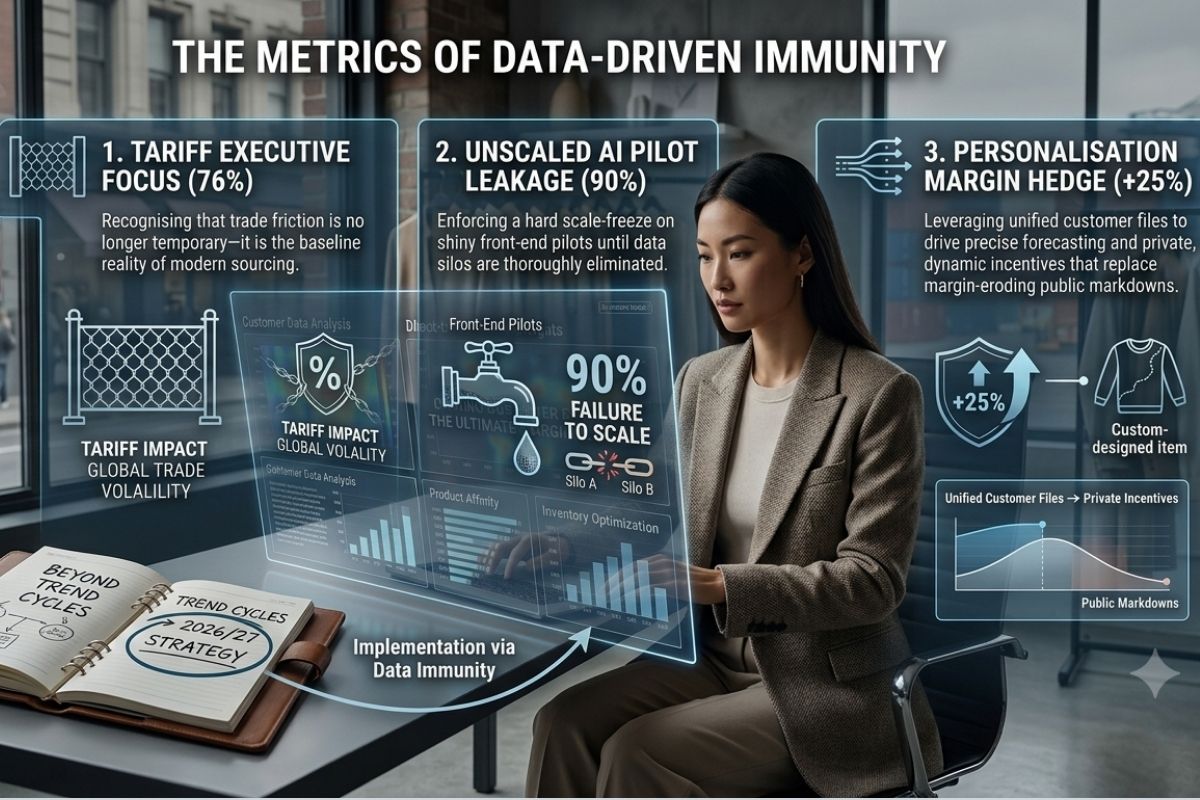
The Fashion Benchmarks
Tariff Executive Focus (76%): The overwhelming proportion of fashion leaders identifying trade duties as the primary macro risk to their operating margins heading into the latter half of the year.
Unscaled AI Pilot Leakage (90%): The industry-wide failure rate for AI experiments that stall due to insufficient, messy, or legacy data architectures underneath them.
Personalisation Margin Hedge (~25%): The proven revenue optimization potential unlocked per customer when first-party data is successfully applied to dynamic forecasting and custom experiences.
Impact Thinking: The 18-Month Reality
“The brands that continue to treat personalisation as an unglamorous marketing nice-to-have are going to discover the hard way that it was actually their ultimate tariff hedge all along. Over the next 18 months, your capacity to absorb external supply shocks will be entirely determined by the cleanliness of your internal data core. Stop playing with surface-level AI pilots and fix the foundations. In 2026, data integrity is the defining engine of margin preservation.” MWB Advisory

Week 27–30: The Executive Roadmap
Week 27: The Convenience Channel – Micro-Format Growth and Out-of-Home Calories.
Week 28: Fashion’s Data Dividend – First-Party Personalisation at Scale.
Week 29: Pharmacy & Health Retail – The Next Retail Media Frontier.
Week 30: General Merchandise – Rebuilding Basket Value in a Discount-Led Market.