



The Growth Series 2026 | Week 31: Fashion & Apparel – The Elevation Mandate
Martin Bailie CEO & founder MWB advisory Ltd
"The brands winning right now aren't the cheapest or the loudest — they're the ones who used AI to buy back the one thing fast fashion took from the industry: precision." — Martin Bailie
Fashion has spent three years apologising for itself—for the margin-eroding discounting, for landfill waste, and for hyper-reactive algorithms pushing consumers toward their fortieth ephemeral micro-trend of the month. That reactive era is closing. The The Business of Fashion -McKinsey State of Fashion 2026 report confirms what I have been stating on store floors and in boardrooms since late last year: 46 percent of fashion executives expect market conditions to worsen before they improve, with 76 percent naming trade tariffs as the single issue that will define the year.
The core insight being missed in boardroom decks is this: the winners in a volatile macroeconomic environment are not those cutting prices to compete in a race to the bottom. They are the operators elevating—tightening assortment breadth, sharpening sizing accuracy, and using artificial intelligence not as a decorative customer-service add-on, but as the foundational operating system for the entire product lifecycle. From upstream trend sensing down to the physical fitting room, precision beats price. Inditex is running this model at an industrial, multi-brand scale; Chalhoub Group is executing a luxury version built on high-touch relationships. Different geographies, identical mandate: Precision beats price.

The Bailie Diagnosis”
My diagnosis from decades of operational execution—including serving on the Primark board, as COO of Lidl UK/IE, and as CEO of Tesco Tata India—is that when market volatility hits, the immediate reflex to ‘discount harder’ loses out every time to ‘get sharper.’
“During my executive tenure across high-volume value fashion and global grocery, the most dangerous P&L trap was attempting to solve an inventory mismatch through public markdowns. At Primark, where precision in volume allocation and cost leadership is everything, I learned that true margin protection is built upstream—long before a garment ever reaches a hanger. In a recent private board session with a major European apparel leadership team, the CMO argued for aggressive mid-season promotional campaigns to defend footfall. I pushed back directly: blanket markdowns destroy brand equity and train the consumer to wait for the sale. The board chose instead to invest in RFID-driven inventory visibility and localized allocation, instantly lifting full-price sell-through rates without sacrificing terminal gross margin.
“The mandate for the next eighteen months is clear: elevate the product, elevate the data discipline behind it, and elevate the standard you hold your AI investments to. Anything less gets outcompeted by a rival who read the same market reports and actually built the underlying stack.”
The Four-Lens Regional Framework
Europe (The Precision Operator): @Inditex reframed its growth story on its 25th anniversary as a listed company around brand diversification paired explicitly with enterprise AI. ZARA full-estate RFID backbone tracks garments in real time across stores to feed twice-weekly replenishment cycles with minimal guesswork. The newer Zaragoza II distribution hub layers advanced robotics and AI demand forecasting directly onto this base, driving virtual try-on sessions across 43 markets with over 7 million recorded interactions.
United States (The Value-and-Resale Rewire): Value creation in American fashion has shifted. McKinsey’s Global Fashion Index illustrates mid-market, design-led brands overtaking luxury as primary value drivers by elevating product quality and store experience rather than discounting. Simultaneously, re-commerce has matured into a core P&L line: the secondhand market has reached $393 billion globally (~10% of total apparel spend), with the US projected to reach $78.8 billion by 2030—unlocked by AI-driven discovery and search engines.
Asia (The Algorithmic Manufacturer): SHEIN’s digitised ‘cloud factory’ platform represents the extreme expression of AI-native fashion, reading demand signals to compress concept-to-doorstep timelines into 7–10 days. While its growth model carries ethical and environmental scrutiny that enterprise brands must not replicate, the underlying pre-production discipline—using AI to validate demand before committing capital to physical inventory—is the exact capability global fashion boards are racing to build.
GCC (The Data-Led Luxury Relationship): Chalhoub Group’s ‘Layla’—a generative luxury-beauty assistant developed in-house—proves Gulf retail is building proprietary AI calibrated to high-touch clienteling. Embedded within their Vision 2033 strategy, Chalhoub treats AI as long-term data infrastructure that prioritises relationship depth over transactional volume, contrasting with Western luxury chatbot pilots that have quietly been paused.
Named World-Class Execution Case Studies
Inditex / Zara (Europe): Full-estate RFID plus agentic AI extending from inventory control into design assistance and store operations; over 7 million virtual try-on sessions recorded across 43 live markets.
Shein (Asia): Cloud-factory bidding platform compressing concept-to-shelf cycles into 7–10 days; an operational lesson in capital de-risking through pre-production testing.
Chalhoub Group (GCC): Layla generative assistant embedded inside a decade-long Vision 2033 infrastructure program, prioritizing relationship depth over transactional velocity.
Kering × Google & EssilorLuxottica × Meta (Cross-Regional): Smart eyewear partnerships signaling that the next major AI interface in fashion may be worn rather than tapped, as the wearables category accelerates

Reality Check: Macro Turbulence & Governance#
Elevation is a deliberate operational strategy, not an automatic guarantee. With 46 percent of executives expecting market conditions to worsen and tariff turbulence restructuring global sourcing maps, supply chain strategist Brittain Ladd’s long-standing critique—that automated fulfillment infrastructure gets oversold relative to its real-world resilience—applies with equal force to fashion’s nearshoring push. An algorithm can reroute a shipment, but it cannot conjure a compliant supplier relationship or certified factory overnight.
Simultaneously, the Apparel Impact Institute warns that the same algorithmic speed that compresses lead times can accelerate overconsumption if ungoverned. C-suite leaders deploying AI-driven demand sensing must build the environmental and ethical governance layer at the exact same time as the forecasting engine—not as an afterthought eighteen months later.
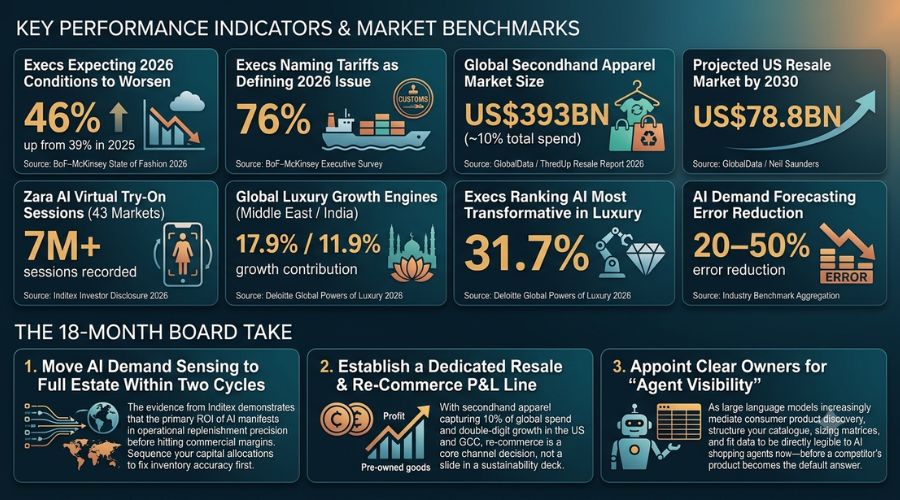
Key Performance Indicators & Market Benchmarks
Execs Expecting 2026 Conditions to Worsen: 46% (up from 39% in 2025) | Source: BoF–McKinsey State of Fashion 2026
Execs Naming Tariffs as Defining 2026 Issue: 76% | Source: BoF–McKinsey Executive Survey
Global Secondhand Apparel Market Size: US$393BN (~10% total spend) | Source: GlobalData / ThredUp Resale Report 2026
Projected US Resale Market by 2030: US$78.8BN | Source: GlobalData / Neil Saunders
Zara AI Virtual Try-On Sessions (43 Markets): 7M+ sessions recorded | Source: Inditex Investor Disclosure 2026
Global Luxury Growth Engines (Middle East / India): 17.9% / 11.9% growth contribution | Source: Deloitte Global Powers of Luxury 2026
Execs Ranking AI Most Transformative in Luxury: 31.7% | Source: Deloitte Global Powers of Luxury 2026
AI Demand Forecasting Error Reduction: 20–50% error reduction | Source: Industry Benchmark Aggregation
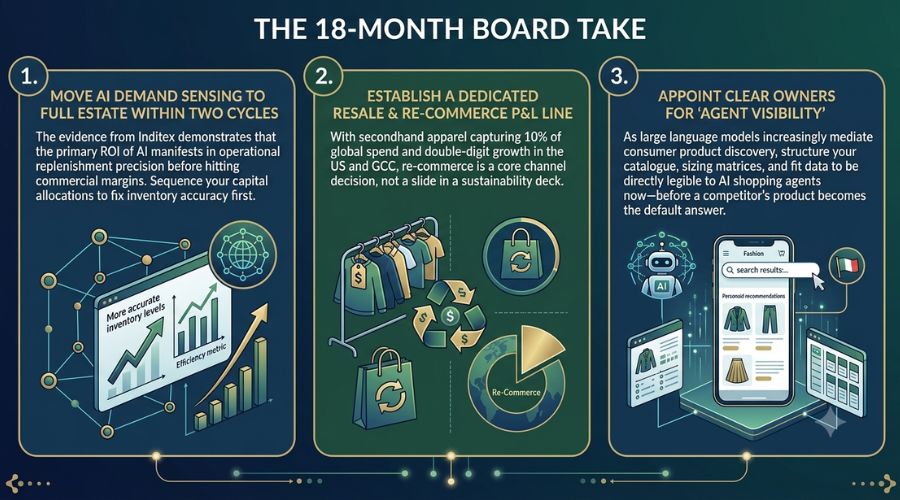
The 18-Month Board Take
1. Move AI Demand Sensing to Full Estate Within Two Cycles: The evidence from Inditex demonstrates that the primary ROI of AI manifests in operational replenishment precision before hitting commercial margins. Sequence your capital allocations to fix inventory accuracy first.
2. Establish a Dedicated Resale & Re-Commerce P&L Line: With secondhand apparel capturing 10% of global spend and double-digit growth in the US and GCC, re-commerce is a core channel decision, not a slide in a sustainability deck.
3. Appoint Clear Owners for ‘Agent Visibility’: As large language models increasingly mediate consumer product discovery, structure your catalogue, sizing matrices, and fit data to be directly legible to AI shopping agents now—before a competitor’s product becomes the default answer.
Week 28–32: The Executive Roadmap
Week 28: Fashion’s Data Dividend – First-Party Personalisation at Scale.
Week 29: Pharmacy & Health Retail – The Next Retail Media Frontier.
Week 30: Grocery & The Basket Autonomy Era – Winning the Agentic Recommendation Layer.
Week 30 Bonus: UK Retail – State of the Nation.
Week 31: Fashion & Apparel – The Elevation Mandate.
Week 32: General Merchandise & Fulfilment – Supply Chain Velocity.